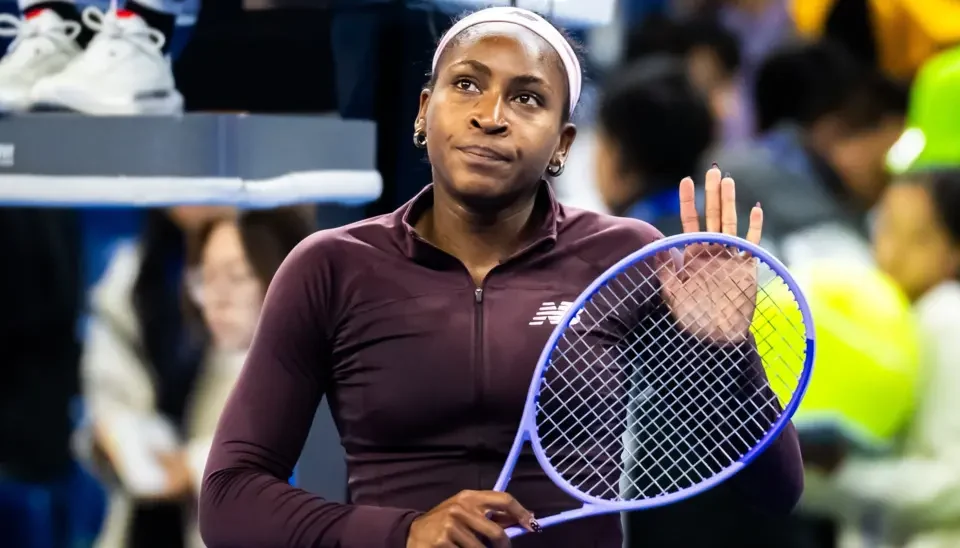

Coco Gauff has spoken out after receiving a wave of racist abuse on social media following her China Open victory over 16-year-old Chinese player Sun Xinran.
The American world No. 4 defeated Sun 7-5, 6-1 in Beijing to reach the last 16, but the result was overshadowed by a disputed moment late in the opening set. Gauff stopped play while serving at 4-5 after noticing a flickering light from the panels surrounding the court.
Sun had appeared to believe she had won the point, but Gauff had already raised her hand to indicate that something was distracting her. The situation quickly became a talking point online, with some fans questioning why the American had stopped the rally at such a crucial stage.
Gauff later explained that the flickering light had affected her during the point and that players had been told they were allowed to continue the rally before requesting a review or replay in such circumstances.
The decision ultimately went in Gauff’s favour. She won the next three points to hold serve for 5-5, went on to take the opening set 7-5 and then dominated the second set, dropping only one game.
But what followed away from the court was far more serious.
Gauff responds to racist comments
After the match, Gauff took to X to explain what had happened. She described the incident as an “unfortunate situation” that was “out of my control” and said she had apologised to Sun after the match.
Gauff also praised her teenage opponent and said Sun had understood the situation.
However, the explanation did not stop the online criticism. Some of the reaction quickly crossed the line from disagreement about a tennis decision into personal and racist abuse.
Gauff directly addressed the issue after responding to a post containing racist language.
“You can dislike me or disagree about what happened without being racist,” Gauff wrote.
She then revealed the scale of the abuse she had received.
“The amount of racist comments/direct messages I’ve received in the last few hours is insane,” she said, before adding that she was “not a cheater or a thief.”
The incident therefore became about much more than a controversial moment during a tennis match. For Gauff, criticism of a decision was one thing; racist attacks were something entirely different.
What happened during the China Open point?
The incident occurred when Gauff was serving at 4-5 in the first set.
Sun appeared to have hit a shot that could have ended the game, but Gauff raised her hand after noticing a flickering light around the court. The American believed the visual distraction had interfered with the rally.
There was immediate confusion because the timing of Gauff’s decision made the incident particularly significant. Had Sun won the point, she would have been in a strong position to take the opening set.
Instead, play was stopped and the situation was reviewed.
Gauff later explained that she had initially noticed something but was not immediately certain what she had seen. When the light flickered again, she decided to stop play.
Reports from the match indicated that the rules allowed players to continue a point and subsequently request a replay when dealing with such an issue. Sun could also have challenged the decision.
That distinction is important because much of the criticism online centred on the suggestion that Gauff had deliberately stopped play to avoid losing the point.
Gauff strongly rejected that interpretation.
The result also showed just how quickly the momentum changed. After holding for 5-5, Gauff closed out the set and then raced through the second, winning 6-1.
She eventually completed a straight-sets victory and moved into the last 16 of the China Open.
Online abuse remains a major problem in women’s tennis
Unfortunately, Gauff’s experience is not an isolated case.
A report released by the WTA and World Tennis in July 2026 revealed the scale of abuse directed at players across social media during the 2025 season.
More than 1.2 million posts and comments were analysed, with more than 12,000 identified as abusive. Of those, 3,726 were classified as serious abuse, including violent, sexual, racist and targeted threats.
There were also signs that efforts to tackle the problem were producing results.
The report said 66% of serious abusive posts or comments were removed, while 35 accounts linked to 12 individuals were escalated to law enforcement. Furthermore, 89% of accounts responsible for serious abuse in 2024 did not reappear in 2025.
Another striking finding was the role of gambling-related anger. According to the report, gamblers were responsible for 42% of verified abusive messages in 2025 and 59% of the most serious abuse.
Those numbers underline why Gauff’s comments matter. Professional athletes are accustomed to criticism, particularly after contentious moments, but racist abuse and threats are not simply part of being a professional sportsperson.
Gauff’s response sends a clear message
Gauff has dealt with intense attention throughout her career, having become one of the biggest names in women’s tennis at a remarkably young age.
She won the US Open in 2023 and the French Open in 2025, and she has repeatedly spoken about the pressure that comes with competing at the highest level.
Her response in Beijing was notable because she did not ask fans to agree with her interpretation of the incident. Instead, she drew a clear line between legitimate criticism and racism.
That distinction is important in modern sport.
Fans are free to question an umpiring decision, debate whether a replay should have been granted or believe a player handled a situation poorly. Those conversations are part of sport.
Racial abuse, however, has nothing to do with analysing tennis.
The China Open incident also showed how quickly a single moment can become a much larger story once it reaches social media. A disputed decision that lasted only seconds on court generated hours of discussion online and ultimately exposed Gauff to abusive messages.
For Sun, the match will also be remembered as a major experience in the early stages of her career. The 16-year-old Chinese player was facing one of the biggest stars in women’s tennis on home soil, and despite losing, she pushed Gauff during a competitive opening set.
Gauff’s eventual 7-5, 6-1 victory means her China Open campaign continues, but the discussion surrounding the match has moved well beyond the scoreline.
The bigger issue is how tennis can continue creating an environment where players can compete, make decisions and even disagree with officials without becoming targets for abuse.
The WTA and World Tennis have already increased monitoring and cooperation with social media platforms and law enforcement. Their latest report suggests that coordinated action can make a difference, but the sheer volume of abuse shows that there is still plenty of work to do.
For Gauff, the message from Beijing was straightforward: fans can disagree with her, criticise her and debate the decision. But there is no justification for racism.
Her focus now will be on tennis as she moves into the last 16 of the China Open.
Stay tuned with ROKOCRICKET for more latest tennis news, match updates, major controversies and stories from around the sporting world. Subscribe and follow us for more.