What are the yellow card suspension rules in the champions league?
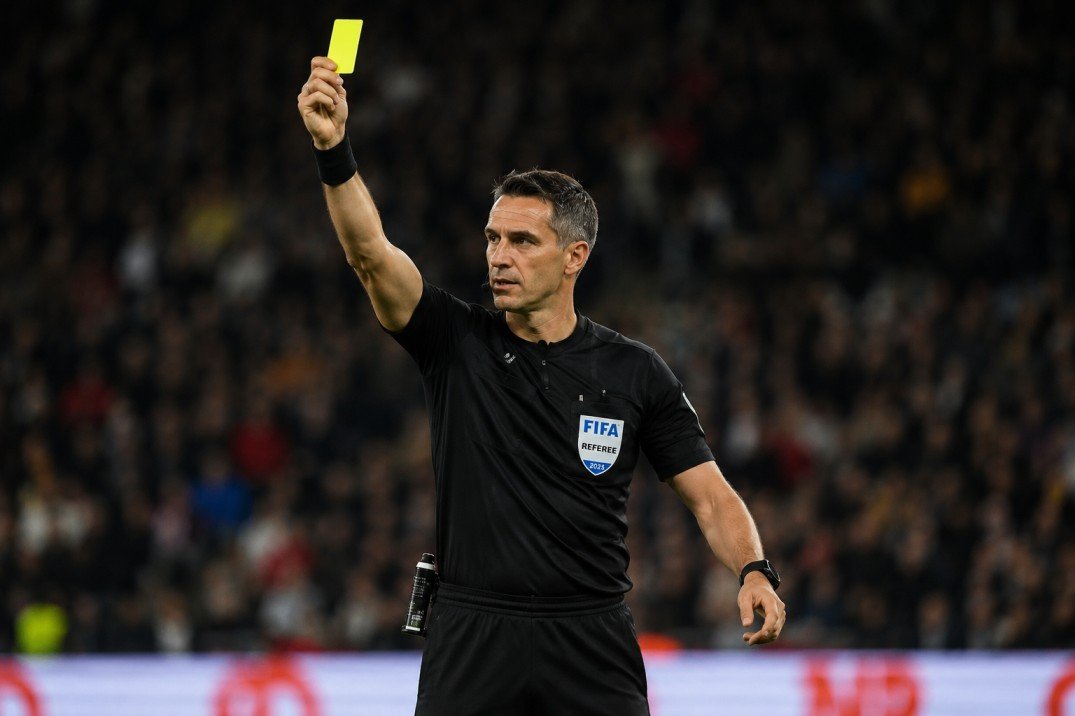
Champions League yellow card suspension rules explained with football players receiving bookings during a UEFA match.
Yellow cards can make a major difference in the UEFA Champions League, particularly when clubs approach the knockout stages and every match carries enormous importance. A player who collects too many cautions risks missing a crucial fixture, potentially leaving their team without one of its key performers.
Under the Champions League disciplinary rules described for the 2026–27 campaign, players face a one-match suspension after receiving four yellow cards during the relevant period of the competition. The rule makes discipline a significant factor for teams competing across the league phase and knockout rounds.
Several players have already attracted attention after collecting two yellow cards in the opening two rounds, putting them closer to a potential suspension as the competition progresses. Armando Obispo and Sergiño Dest of PSV Eindhoven, Inter Milan midfielder Hakan Çalhanoğlu, Club Brugge’s Jan Virgili and Shakhtar Donetsk’s Marlon Gomes are among the players listed with two cautions.
The key question for supporters is straightforward: how many yellow cards lead to a Champions League suspension, when are bookings wiped out, and which players need to be careful in upcoming matches?
How many yellow cards lead to a Champions League suspension?
A player receives a one-match suspension after accumulating four yellow cards during the applicable disciplinary period. The system is designed to discourage repeated offences, including reckless challenges, persistent fouling, dissent and other actions that warrant a caution.
Unlike a straight red card, which can result in an immediate suspension, yellow-card bans depend on the number of cautions a player accumulates across multiple matches.
For example, a player who receives yellow cards in four separate Champions League fixtures can be suspended for the next applicable match. The ban can become particularly costly if it forces a regular starter to miss a quarter-final or another decisive knockout encounter.
Players must therefore balance their competitive approach with the risk of disciplinary action. A defender who makes an unnecessary challenge or a midfielder who repeatedly protests against refereeing decisions could put their availability for a future fixture in danger.
When are Champions League yellow cards wiped out?
The timing of the yellow-card reset is another important part of the disciplinary system.
Under the rules described for this competition, accumulated cautions are cleared after the quarter-finals, preventing players from carrying their earlier yellow cards into the semi-finals. This measure helps ensure that players are not suspended from the final solely because of accumulated cautions during the earlier rounds.
The distinction matters because a suspension for accumulated bookings can affect a team’s plans even when a player has not committed an offence serious enough to warrant a red card.
However, a yellow-card reset does not automatically cancel a suspension that has already been incurred. Players must serve applicable suspensions, and disciplinary sanctions for serious offences can remain relevant beyond the ordinary booking threshold.
Supporters should also distinguish between the yellow-card accumulation rule and other disciplinary penalties. A straight red card, for instance, is governed by separate disciplinary provisions and can carry a different suspension depending on the offence.
Which players have the most yellow cards in the Champions League?
The following five players have been identified with two yellow cards after the opening two rounds of matches in the supplied list:
- Armando Obispo — PSV Eindhoven
- Hakan Çalhanoğlu — Inter Milan
- Jan Virgili — Club Brugge
- Marlon Gomes — Shakhtar Donetsk
- Sergiño Dest — PSV Eindhoven
These players have reached half of the four-card threshold described above. Another caution would take their individual totals to three, leaving them one booking away from the stated suspension limit.
For PSV Eindhoven, having two players on the list makes discipline particularly worth watching. Obispo and Dest will need to manage their challenges carefully, especially in matches where opponents try to exploit defensive pressure or draw fouls.
Çalhanoğlu’s situation is also notable because midfielders often find themselves involved in tactical fouls designed to stop counterattacks. A mistimed challenge can earn a caution, while unnecessary dissent can create an additional risk.
For Club Brugge and Shakhtar Donetsk, the same principle applies. Players must remain aggressive enough to compete at the highest level without repeatedly putting themselves in the referee’s notebook.
These totals relate to the player list supplied for this report; they should not be treated as a live, independently verified disciplinary table.
Can players be suspended after six, eight or 10 yellow cards?
Yes. Under the accumulation system described in the supplied information, further suspensions can follow when a player reaches six, eight or 10 yellow cards.
The principle is that a player does not escape disciplinary consequences after serving the first ban. Continued accumulation can trigger further one-match suspensions at the relevant thresholds.
That makes the four-card mark only the first major warning for players who feature regularly throughout the tournament. A footballer who repeatedly receives cautions could face additional absences as the competition advances.
For clubs, this creates a squad-management challenge. Coaches may have to consider a player’s disciplinary record when selecting a team for an important fixture, particularly if a suspension could leave a position short of experienced cover.
The risk is especially significant for defenders and defensive midfielders, who often make tactical fouls to prevent dangerous attacks. Even when a challenge helps the team in the short term, the resulting booking can create problems for a later match.
Do the same yellow card rules apply in the Europa League and Conference League?
The supplied rules also identify the UEFA Europa League and UEFA Conference League as competitions that use the same general approach to accumulated yellow cards.
That means players competing in Europe’s three major men’s club competitions must pay attention to their disciplinary records rather than focusing exclusively on goals, assists and match results.
Nevertheless, supporters should check the regulations for the specific competition and season before relying on an exact suspension threshold. UEFA’s competition regulations determine the applicable booking limits, reset points and treatment of outstanding suspensions.
Why yellow cards could influence the Champions League knockout stage
As the Champions League progresses, the consequences of a booking can become more serious. During the league phase, teams have multiple opportunities to recover from a poor result. In a knockout tie, however, losing a regular starter for one leg can significantly affect tactical plans.
A suspended centre-back may force a coach to change the defensive partnership. The absence of a holding midfielder can weaken protection in front of the defence, while losing an influential playmaker may reduce a team’s ability to control possession.
Players also face a psychological challenge. Knowing that another caution could trigger a ban may influence how they approach challenges, particularly against fast attackers or during tense closing stages.
That does not mean players should avoid every difficult tackle. Instead, they need to make better decisions, stay composed when disputing decisions and avoid preventable fouls that offer little tactical benefit.
For supporters, the disciplinary table is therefore more than a statistical footnote. It can provide an early indication of which players could become unavailable at a critical point in the tournament.
Stay tuned to ROKOCRICKET for the latest Champions League news, disciplinary updates, match analysis and football stories. Subscribe to keep up with the developments that could shape Europe’s biggest club competition.