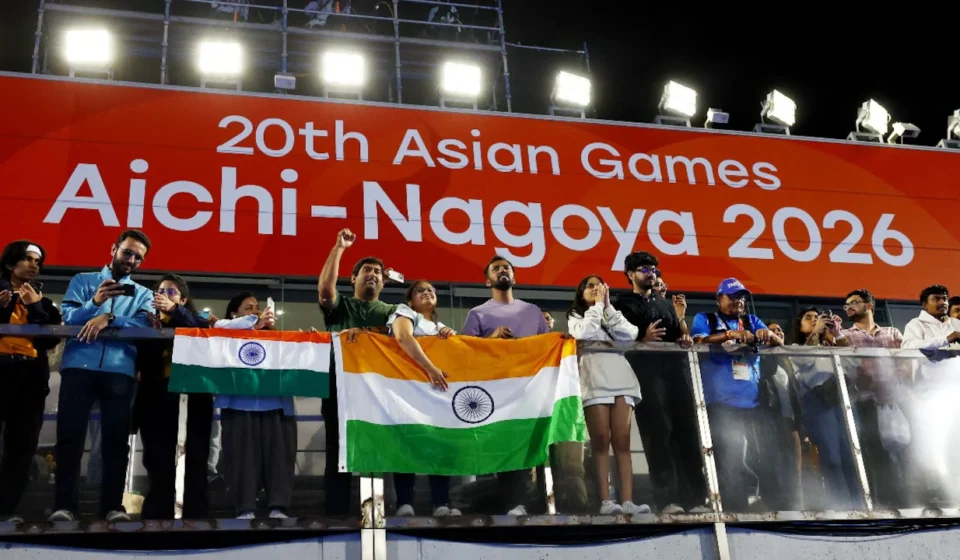

India’s campaign at the Asian Games 2026 in Aichi-Nagoya has come to an end, and the final medal tally presents a picture that is both encouraging and demanding. The Indian contingent finished fourth with 85 medals — 21 gold, 27 silver and 37 bronze. China topped the standings, followed by Japan and South Korea.
At first glance, 85 medals may look like a disappointing number after India created history with 106 medals at Hangzhou. But the bigger picture tells a different story. The 2026 campaign remains India’s second-best Asian Games performance in terms of total medals, while the fourth-place finish matches India’s position from Hangzhou.
The problem, however, is that India expected another major jump after the record-breaking 2023 edition. Instead, the medal tally dropped by 21 and the gold count fell from 28 to 21. That gap is the biggest takeaway from Aichi-Nagoya.
A mixed campaign for India
India’s performance was not short of historic moments. Several athletes and teams reached milestones that had never been achieved before.
Archery was arguably one of the biggest success stories. India won nine medals, including five golds, with Kumkum Mohod becoming the first Indian to win an individual women’s recurve gold at the Asian Games. The women’s recurve team also created history by ending South Korea’s long-standing dominance in the event.
Shooting also produced some memorable performances despite falling well short of its previous overall tally. Neeru Dhanda became the centre of India’s campaign after winning individual trap gold and another gold with Kynan Chenai in mixed trap. Her individual triumph ended a 48-year wait for India in the event.
Boxing delivered another major positive. India won three gold medals, with Lovlina Borgohain, Parveen Hooda and Ankush Panghal finishing at the top of their respective categories. Lovlina’s victory was particularly significant as she became only the second Indian woman after Mary Kom to win an Asian Games boxing gold.
Golf also gave Indian fans a historic reason to celebrate. Pranavi Urs became the first Indian woman to win an individual Asian Games golf gold, while the women’s team added a silver medal.
Hockey and cricket finish the campaign in style
Team sports once again proved to be one of India’s strongest areas.
Both Indian hockey teams won gold. The women’s team ended a 44-year wait for an Asian Games gold by beating China 1-0 in the final. The result also secured India’s direct qualification for the Los Angeles 2028 Olympics. The men’s team successfully defended its Asian Games title after defeating Malaysia 5-1 and also secured Olympic qualification.
Cricket produced another clean sweep. India retained both the men’s and women’s T20 titles. The women defeated Sri Lanka by 147 runs, while the men defeated Pakistan by 19 runs in the final.
Kabaddi followed a similar script, with both Indian teams winning gold and successfully defending their titles. The late surge from cricket, hockey and kabaddi helped India finish the Games strongly.
Athletics and shooting raise the biggest questions
If India wants to move from fourth place towards the top three, athletics and shooting will require serious attention.
Athletics produced India’s highest overall medal haul with 24 medals, but the number of golds was nowhere near what the country would have hoped for. Several established names came close to the top but had to settle for silver or missed the competition altogether. Neeraj Chopra’s absence was particularly significant for India’s medal ambitions.
Shooting, meanwhile, finished with 15 medals. That sounds impressive on its own, but it represents a clear decline from Hangzhou, where India won 22 shooting medals, including seven golds. This time, the shooting contingent collected three golds, eight silvers and four bronze medals.
The large number of silver medals also tells its own story. India won 27 silvers, and several of those came from athletes who were close to winning gold. Converting even a handful of those second-place finishes into victories would have changed the overall medal picture significantly.
The biggest lesson from Aichi-Nagoya
The most important lesson is that India’s sporting base is becoming wider, but consistency at the highest level remains a challenge.
India is no longer dependent on just one or two sports. Archery, boxing, wrestling, hockey, cricket, golf and kabaddi all produced important results. Wrestling won six medals, including two golds, while archery’s five golds made it India’s most successful discipline in terms of gold medals.
At the same time, tennis ended without a medal, while several other disciplines failed to match expectations. The Games also exposed logistical problems, including transportation and accommodation difficulties caused partly by the absence of a traditional athletes’ village. The Olympic Council of Asia acknowledged those challenges after the Games.
These factors cannot be used as an excuse for every missed medal, but they are important when assessing the overall performance.
India therefore leaves Aichi-Nagoya with two very different messages. The first is that the country is producing more medal-winning athletes across a wider range of sports. The second is that the gap between winning a medal and winning gold remains significant.
The final tally of 21 gold, 27 silver and 37 bronze medals places India fourth in Asia. It is not the record-breaking performance fans witnessed in Hangzhou, but it is still the country’s second-best Asian Games medal haul.
The real test now is what happens next. With the Los Angeles Olympics approaching, India has an opportunity to turn the lessons from Aichi-Nagoya into better preparation, stronger depth and more gold medals.
For Indian sport, the Asian Games 2026 campaign was not simply about the number 85. It was a reminder that progress is rarely a straight line. Some stars delivered, some new champions emerged and several weaknesses became impossible to ignore.
The next step is to learn from all three.
Stay tuned with ROKOCRICKET for more updates, analysis and stories from Indian cricket and sports. Don’t forget to subscribe and share your opinion on India’s Asian Games 2026 campaign in the comments.