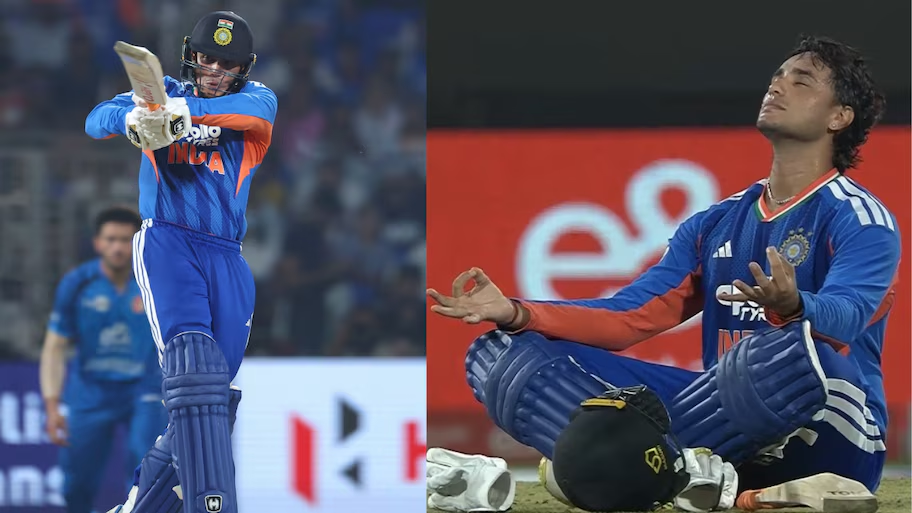
Abhishek Sharma Fastest Hundred: 30-Ball Record Stuns Afghanistan as India Witnesses History

Abhishek Sharma Fastest Hundred: Abhishek Sharma produced a breathtaking batting masterclass against Afghanistan in the third T20I in Delhi on Thursday, September 17, smashing a century in just 30 balls and rewriting India’s record books.
The left-handed opener walked out at the Arun Jaitley Stadium and turned the match into his own personal highlight reel. Boundaries came almost at will as Afghanistan’s bowling attack struggled to find a way to slow him down.
By the time Abhishek reached his hundred, he had already broken one of Indian cricket’s long-standing T20I records. His 30-ball century surpassed the previous Indian record held by Rohit Sharma, who had smashed a 35-ball hundred against Sri Lanka in Indore in 2017. Abhishek’s effort was five balls quicker.
But there was even more to the record.
Abhishek Sharma’s 30-ball hundred is now the fastest T20I century by a batter representing an ICC Full Member nation. Before this innings, Zimbabwe’s Sikandar Raza and New Zealand’s Finn Allen shared the Full Member record at 33 balls. David Miller and Rohit Sharma were next with 35-ball centuries.
Abhishek Sharma Turns Delhi Into His Own Batting Stage
The innings was remarkable not simply because of the century, but because of the speed at which Abhishek accelerated.
He brought up his fifty from only 16 balls, giving Afghanistan an early warning of what was coming. He then took the attack to another level, scoring his next 51 runs in just 14 deliveries to complete his century from 30 balls.
Abhishek eventually finished with a stunning 108 from 34 balls, including nine fours and 11 sixes.
That means 102 of his 108 runs came exclusively through boundaries.
His strike rate was an extraordinary 317.65, a number that tells only part of the story. The more remarkable statistic is the way he maintained such a brutal scoring rate while facing an international bowling attack.
Rashid Khan eventually ended the madness, dismissing Abhishek for 108 shortly before he could take the innings even further. The wicket came just before the halfway stage of India’s innings.
From Rohit Sharma’s Record to T20I History
For years, Rohit Sharma’s 35-ball century against Sri Lanka had stood as the fastest T20I hundred by an Indian.
That record has now changed hands.
The latest list of fastest T20I centuries by Full Member batters reads:
| Batter | Balls | Team | Opponent |
|---|---|---|---|
| Abhishek Sharma | 30 | India | Afghanistan |
| Sikandar Raza | 33 | Zimbabwe | Gambia |
| Finn Allen | 33 | New Zealand | South Africa |
| David Miller | 35 | South Africa | Bangladesh |
| Rohit Sharma | 35 | India | Sri Lanka |
There is, however, an important distinction when discussing the fastest T20I century overall.
Abhishek is third on the global T20I list because Associate-nation batters have gone even faster. Estonia’s Sahil Chauhan holds the overall mark with a 27-ball hundred, while Turkey’s Muhammad Fahad reached three figures in 29 balls. Since India is an ICC Full Member, Abhishek’s achievement is the fastest among Full Member nations.
And that makes the achievement even more interesting. Abhishek Sharma has entered a very small group of players who have scored a T20I century in fewer than 31 balls.
India Score 100 Runs in the Powerplay
Abhishek wasn’t the only reason India made history in Delhi.
The opening partnership with Sanju Samson also produced a remarkable powerplay.
India crossed the 100-run mark inside the first six overs, setting a new team benchmark. The pair combined for an extraordinary 100 runs during the powerplay, with Samson providing support while Abhishek launched attack after attack at the other end.
For a team that had already taken a 2-0 lead in the three-match series, India had every reason to experiment in the final match. Instead, Abhishek came out with a completely different mission: attack from ball one.
Afghanistan had already been beaten in the first two matches, with India winning both games by seven wickets. The second victory gave India an unassailable series lead before the Delhi finale.
But Abhishek ensured the final match would be remembered for something much bigger than the series result.
The Celebration Was Almost as Calm as the Batting Was Explosive
Perhaps the most eye-catching moment came after Abhishek completed his century.
Instead of producing a wild celebration, the Indian batter removed his helmet, sat down on the field and appeared to meditate in a cross-legged position.
The contrast was striking.
Thirty balls of absolute destruction were followed by a moment of complete calm.
The celebration quickly attracted attention, with reports describing it as a meditation or yoga-style celebration. It gave the record-breaking innings an unusual finishing touch and quickly became one of the most talked-about moments of the match.
On one side was Abhishek smashing 11 sixes and nine fours. On the other was the same player sitting quietly in meditation moments after reaching one of the biggest milestones of his career.
That image may well become one of the defining pictures of his 2026 season.
Abhishek Sharma’s Explosive Form Continues
The century also did not come completely out of nowhere.
Abhishek had already made an impact earlier in the Afghanistan series. He scored 82 from 32 balls in the opening T20I, while he added 39 from 19 balls in the second match. The 108 in Delhi took his performances in the series to another level.
His batting approach has become increasingly clear: he wants to put pressure on the opposition before the bowlers have time to settle.
That approach is particularly valuable in T20 cricket, where a fast start can completely change the equation of an innings.
The Delhi knock was perhaps the clearest example yet of what Abhishek can do when that aggressive method clicks.
And the timing could hardly be better for India.
With the T20 format increasingly becoming a game of power, pace and fearless batting, having a player capable of scoring 100 from 30 balls gives India another dangerous weapon at the top of the order.
A Record That Will Be Difficult to Forget
Records in T20 cricket can disappear quickly. The format is designed for extraordinary performances, and another batter somewhere in the world could always produce something even more spectacular.
But Abhishek Sharma’s 30-ball century will remain significant for Indian cricket.
He broke Rohit Sharma’s 35-ball record.
He moved past the previous Full Member benchmark of 33 balls.
He smashed 108 runs from only 34 deliveries.
He hit 20 boundaries, with 11 sixes and nine fours.
And India reached 100 during the powerplay for the first time in men’s T20I cricket.
Most importantly, he did it while playing his natural game rather than trying to manufacture a record.
That may be the most frightening part for opposition teams.
The record was the result of the innings. The attacking intent was the reason it happened.
Abhishek Sharma has now officially put his name among the fastest century-makers in T20I history. And if this Delhi performance is any indication, Indian cricket fans may have plenty more explosive innings to look forward to.
Stay tuned with ROKOCRICKET for more breaking cricket stories, records, match updates and player news. If you enjoyed this story, don’t forget to subscribe and share your thoughts in the comments: where does Abhishek Sharma’s 30-ball century rank among the most explosive T20I knocks you have watched?