Harmanpreet Kaur breaks down after explosive 91 against Zimbabwe
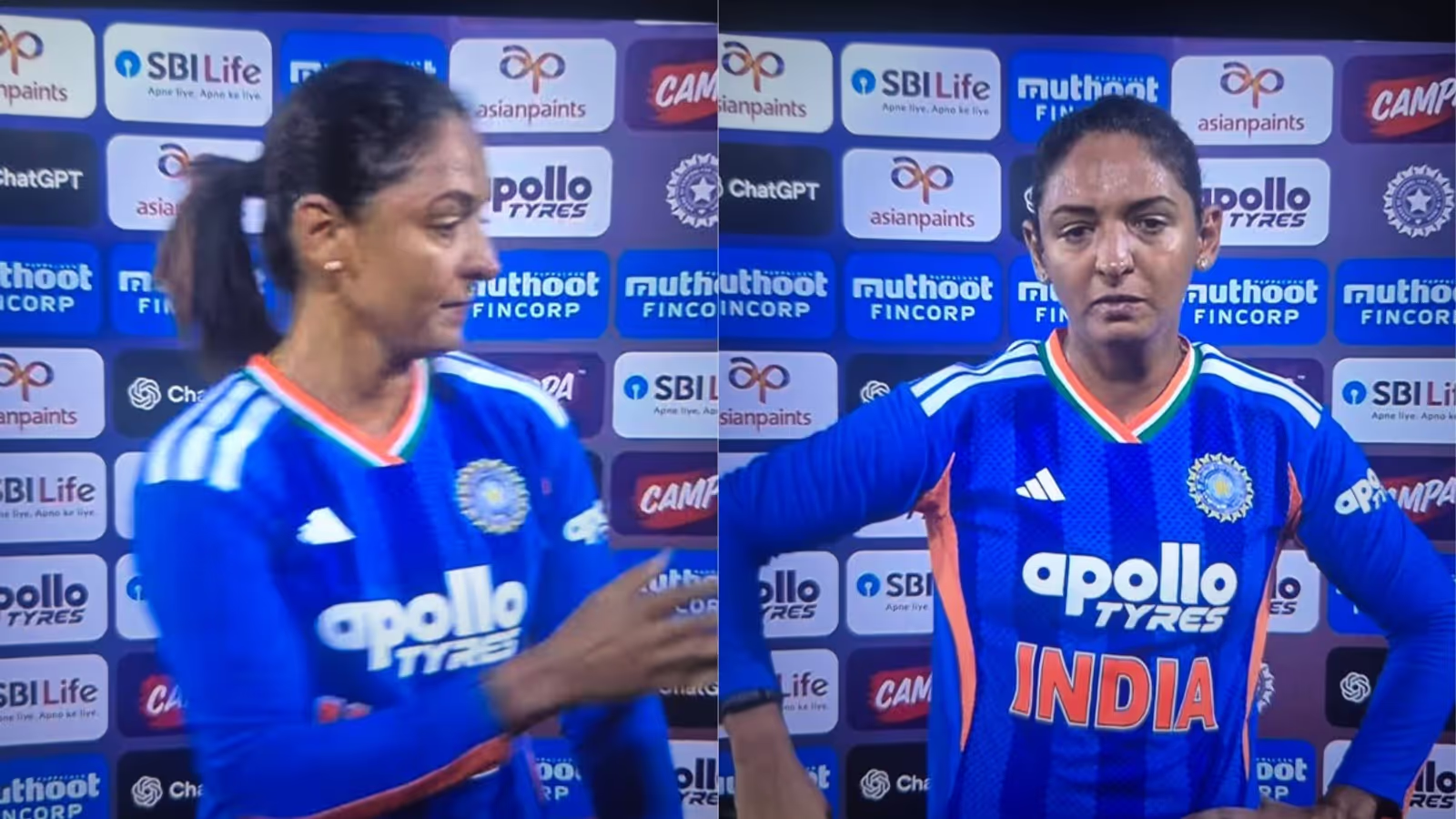
Harmanpreet Kaur celebrates her unbeaten 91-run innings against Zimbabwe in the third women's T20I in Raipur on October 20, 2026.
Harmanpreet Kaur produced a stunning batting performance against Zimbabwe in the third T20 International in Raipur on October 20, 2026, but the Indian captain’s emotional reaction after the innings quickly became the biggest talking point. The experienced batter smashed an unbeaten 91 off just 41 balls, recording her highest T20I score since 2018, before appearing visibly emotional during a post-innings interview.
Harmanpreet’s remarkable knock helped India post 216 for seven, giving the hosts a formidable total in the series finale. Batting at No. 4, she struck 10 fours and five sixes, combining power with calculated aggression to put Zimbabwe’s bowlers under sustained pressure.
However, it was the moment after the innings that attracted widespread attention. While speaking to the broadcaster, Harmanpreet appeared to struggle with her emotions, lowered her head and wiped her face before answering the final question in a choked voice. Once the interview ended, she tossed the microphone aside and walked away.
The reason behind her emotional response was not officially confirmed. While speculation surrounding her captaincy has circulated, it would be premature to attribute her reaction to any particular issue without confirmation from the player or the team management.
Harmanpreet Kaur ends an eight-year wait for a major T20I score
Harmanpreet’s unbeaten 91 was a significant personal milestone. Before the Raipur contest, her highest T20I score had been 103 against New Zealand on November 9, 2018. In the years that followed, she struggled to reproduce that level of individual scoring consistency in the format, although she continued to play important roles for India.
Her 91 against Zimbabwe marked her highest T20I score since that 2018 performance. It also surpassed her previous best of 77 against Bangladesh in March 2014 among the earlier scores highlighted in the match coverage.
The innings demonstrated how quickly an experienced international batter can change the momentum of a match. Harmanpreet initially settled at the crease, but once she found her rhythm, Zimbabwe’s bowlers had few answers to her attacking stroke play.
Speaking after the innings, Harmanpreet explained that she had spent additional time working in the nets following the first two matches. She credited batting coach Himanshu Veingankar for his contribution to her preparation and also acknowledged former India coach WV Raman for advice that helped her approach the game.
“It feels good,” Harmanpreet said, explaining that she wanted to enjoy her batting and spend as much time at the crease as possible.
Her comments reflected a clear focus on rebuilding rhythm and confidence rather than simply chasing a big score. The result was one of her most memorable T20I innings in recent years.
How Harmanpreet turned a slow start into a batting masterclass
Harmanpreet arrived at the crease during the eighth over of India’s innings and immediately showed her intent by finding the boundary. However, she did not begin at an explosive pace, reaching 11 runs from 11 balls as she assessed the conditions and settled into her innings.
The turning point came in the 14th over, when she attacked Kudakwashe Chigora and collected 20 runs through a combination of boundaries and sixes. That over changed the tempo of the innings and put Zimbabwe under considerable pressure.
Harmanpreet continued her assault in the 16th over, taking 14 runs from Nomvelo Sibanda’s bowling. She reached her half-century from just 25 balls, underlining the acceleration that had transformed her innings.
The Indian batter then targeted Beloved Biza, striking two sixes in the 17th over. She maintained the pressure through the closing stages, although the fall of wickets at the other end limited her opportunities to chase a century.
Her unbeaten 91 off 41 balls came at a strike rate of approximately 221.95. It was a powerful reminder of her ability to dominate bowling attacks when she finds the right balance between patience and aggression.
Despite falling nine runs short of a century, Harmanpreet had already delivered the kind of innings that can define a T20 match.
Shafali Verma provides the perfect support
Harmanpreet was not the only Indian batter to make a major contribution. Shafali Verma produced an equally entertaining performance at the top of the order, scoring 69 from 37 deliveries with six fours and five sixes.
The partnership between Shafali and Harmanpreet proved crucial to India’s scoring surge. The pair added 84 runs for the third wicket, combining Shafali’s attacking approach with Harmanpreet’s ability to accelerate after a measured start.
Anushka Sharma also contributed 28 from 20 balls, helping India maintain momentum during the middle and closing stages.
India eventually finished on 216 for seven, with only three batters reaching double figures. The score highlighted the importance of the major contributions from Shafali and Harmanpreet, who supplied the bulk of the innings’ attacking power.
For Zimbabwe, containing the two senior Indian batters proved difficult once they began finding the boundary regularly. The inability to break their momentum during the middle overs allowed India to build a total that placed significant pressure on the visitors.
Captaincy speculation adds another layer to the story
Harmanpreet’s emotional appearance has also brought renewed attention to reports surrounding India’s leadership changes. However, the precise circumstances behind her reaction remain unconfirmed, and her interview alone does not establish that captaincy discussions were responsible.
Harmanpreet has been one of the most influential figures in Indian women’s cricket for more than a decade. She first took charge of India’s T20I side in 2016 and subsequently became a central figure in the team’s leadership structure across formats.
Her aggressive batting, competitive temperament and experience have made her a prominent name in the international game. Any change to her leadership responsibilities would naturally attract considerable attention, given her contribution to India’s rise in women’s cricket.
Smriti Mandhana, meanwhile, has also established herself as one of India’s most dependable batters and senior leaders. The two players have shared the dressing room for years and played major roles in many of the team’s memorable performances.
Suggestions of tension between Harmanpreet and Mandhana have circulated amid discussion of the reported leadership changes. Nevertheless, claims about a breakdown in their relationship should be treated cautiously unless supported by clear evidence or statements from those involved. Body language during a match or team huddle is not sufficient to establish a personal dispute.
For now, Harmanpreet’s batting performance offers a more concrete measure of her contribution. Her 91 against Zimbabwe showed that she remains capable of delivering a match-changing innings, regardless of the wider discussion surrounding Indian women’s cricket.
India continue to make history with six-hitting power
India’s total of 216 for seven was another milestone in an increasingly aggressive phase of women’s T20I cricket. The team struck 11 sixes against Zimbabwe, highlighting the growing emphasis on boundary-hitting and high scoring.
India had already recorded 13 sixes in a T20I innings against Sri Lanka at the 2026 Asian Games, according to the supplied match report. The Zimbabwe contest further underlined the team’s ability to generate power through the middle and death overs.
The reported calendar-year tally of 128 sixes in 2026 also placed India ahead of South Africa, which had recorded 77 sixes during the same period. These figures illustrate the scale of India’s attacking approach, although the final statistical records should be checked against official match data.
Harmanpreet and Shafali represent two different but complementary aspects of that strategy. Shafali can put a bowling attack under pressure from the opening overs, while Harmanpreet can assess the situation before launching an aggressive assault.
That combination gives India flexibility in setting totals. It also allows the team to recover from slower starts, provided its middle-order batters can build partnerships and finish strongly.
Stay tuned to ROKOCRICKET for the latest cricket news, match reports, player updates and breaking stories from Indian and international cricket. Subscribe to stay informed about the biggest developments in the game.