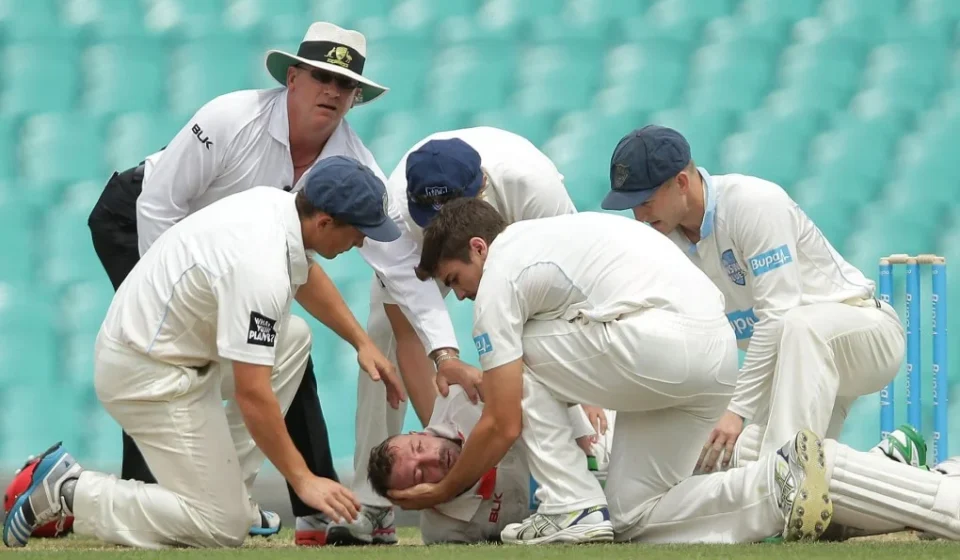

The death of Phil Hughes remains one of the darkest moments in cricket history. The Australian batsman was just 25 years old when he suffered a fatal head and neck injury after being struck by a short-pitched delivery during a Sheffield Shield match at the Sydney Cricket Ground (SCG) on November 25, 2014. Two days later, on November 27, Hughes passed away in hospital, leaving the cricketing world devastated.
Hughes was representing South Australia against New South Wales when the tragic incident occurred. What began as an ordinary day of domestic cricket quickly turned into an emergency that brought players, officials and supporters together in disbelief. Despite receiving medical attention on the field and undergoing emergency surgery, the young batsman never regained consciousness.
More than a decade later, the story of Phillip Hughes continues to resonate with cricket fans around the world. His death changed the way many people viewed player safety, protective equipment and the risks involved in professional cricket. It also left behind a powerful reminder that even the most familiar sporting situations can carry unexpected dangers.
What happened to Phil Hughes during the match?
The incident took place on the opening day of the Sheffield Shield match between South Australia and New South Wales at the SCG in Sydney. Hughes was batting for South Australia and had reached 63 not out, looking to strengthen his position as he pursued another opportunity to represent Australia at Test level.
New South Wales fast bowler Sean Abbott was bowling when Hughes attempted to play a short-pitched delivery. The ball struck him in the neck, just below the protection provided by his helmet. Hughes immediately collapsed on the pitch, prompting players and medical staff to rush to his aid.
The atmosphere at the ground changed within seconds. Teammates who had been competing fiercely only moments earlier were suddenly confronted with a medical emergency. Hughes received treatment on the field before being taken to St Vincent’s Hospital in Sydney.
Doctors performed emergency surgery, and Hughes was placed in an induced coma in intensive care. His condition remained critical over the following two days as his family, teammates and supporters waited anxiously for updates.
On November 27, 2014, Cricket Australia confirmed that Hughes had died without regaining consciousness. He was 25.
The match was abandoned following the incident. The immediate priority for everyone involved was no longer cricket, but the health of a young player whose career had been progressing towards another international opportunity.
Phil Hughes death: what caused the fatal injury?
The fatal injury was caused by a cricket ball striking Hughes in the neck. Medical explanations reported at the time indicated that the impact damaged a major blood vessel supplying the brain, resulting in a catastrophic brain injury.
The injury involved a rare condition associated with blunt trauma to the neck. The damage caused severe bleeding and left doctors facing an extremely difficult medical situation.
Cricket is played with a hard ball that can travel at considerable speed, particularly when delivered by fast bowlers. Helmets, pads, gloves and other protective equipment reduce many risks, but they cannot eliminate every possible injury.
Hughes was wearing a helmet when he was struck. However, the ball hit an area that was not adequately protected by the equipment he was using at the time.
His death led to renewed discussions about the design of cricket helmets and the protection offered around the back and sides of the head, as well as the neck. Manufacturers, governing bodies and players examined whether existing equipment could be improved to reduce the risk of similar injuries.
It is important to recognise that Hughes’s death was an exceptionally rare sporting tragedy. The incident did not mean that cricket was inherently unsafe, but it highlighted the need to continually assess risks and improve safety measures wherever possible.
Who was Phil Hughes? A promising Australian batting talent
Phillip Joel Hughes was born on November 30, 1988, in Macksville, New South Wales, Australia. From an early age, he demonstrated considerable talent with the bat and developed into one of the country’s most promising young cricketers.
Hughes’s journey from a small Australian town to the international stage reflected years of hard work, discipline and determination. He progressed through junior cricket before establishing himself in domestic competition with New South Wales.
His performances quickly attracted attention. Hughes was a left-handed opening batter known for his attacking approach, ability to score quickly and willingness to take on bowlers.
He made his Test debut for Australia against South Africa in February 2009. Still only 20, Hughes announced himself on the international stage during the series, producing centuries in both innings of the second Test in Durban. His performances demonstrated the potential that had made him such an exciting prospect.
Over the course of his international career, Hughes represented Australia in 26 Test matches, 25 One-Day Internationals and one Twenty20 International.
He also played domestic cricket for several teams and continued working towards a more permanent place in Australia’s international line-up. Although his career included periods of inconsistent form and competition for selection, his ability was never in serious doubt.
By November 2014, Hughes was still young enough to have many years of cricket ahead of him. His unbeaten 63 in the match against New South Wales was another opportunity to demonstrate his value as a batter.
That is one reason his death was so difficult for supporters to accept. Cricket had lost not only an established international player, but also a young sportsman whose best years might still have been ahead of him.
Sean Abbott and the aftermath of the tragedy
Sean Abbott, the bowler who delivered the ball that struck Hughes, was also deeply affected by the incident. Abbott was a young fast bowler, and the tragedy unfolded during a competitive domestic match in which both players were doing their jobs.
In the days following Hughes’s death, the cricket community expressed concern for Abbott as well as for Hughes’s family and teammates. The emotional consequences of such an incident extended far beyond the player who suffered the injury.
The circumstances were examined during a formal inquest in New South Wales in 2016. Coroner Michael Barnes found no malicious intent behind the delivery and did not assign blame to Abbott or anyone else for Hughes’s death.
The findings were significant because they distinguished between the tragic outcome and the intentions of the people involved. Short-pitched bowling is a recognised part of cricket, and the evidence did not establish that Abbott had deliberately attempted to cause a fatal injury.
The inquest also examined aspects of playing conditions, medical response and protective equipment. Its findings contributed to wider discussions about the responsibilities of cricket authorities to make the sport as safe as reasonably possible.
For the players who knew Hughes, however, the personal loss could not be reduced to questions about rules or equipment. A teammate and friend had died while doing something he loved.
How the death of Phil Hughes changed cricket
The death of Phil Hughes prompted a worldwide reassessment of cricket safety. Players, coaches, medical professionals and equipment manufacturers considered how the game could better protect batters from dangerous impacts.
One of the most visible areas of attention was helmet design. Cricket helmets had already evolved over many years, but the incident underlined the importance of examining vulnerable areas that traditional designs did not fully cover.
The development and adoption of improved helmets, including designs offering additional protection at the back of the head and around the neck, became an important part of the broader safety conversation. Neck protectors also received greater attention as players and manufacturers explored ways to reduce exposure to fast-moving cricket balls.
Safety standards continued to develop, with governing bodies and manufacturers assessing protective equipment against the demands of modern cricket.
The tragedy also raised questions about emergency medical arrangements at cricket grounds. The speed of medical assessment, access to trained personnel and the coordination of emergency services are essential considerations whenever a serious injury occurs.
No single change can eliminate every risk in a sport involving a hard ball and high-speed bowling. Nevertheless, Hughes’s death reinforced the importance of learning from accidents and taking practical steps to protect players.
His legacy is therefore connected not only to his batting achievements, but also to the ongoing effort to make cricket safer for future generations.
The cricket world mourns Phil Hughes
The response to Hughes’s death extended far beyond Australia. International cricketers, former players, administrators and fans expressed their grief, demonstrating how strongly the young batter had connected with people throughout the sport.
Australian captain Michael Clarke was among those most visibly affected. Clarke read a statement on behalf of the Hughes family following the announcement of his death, struggling to contain his emotions as he spoke about his teammate.
Tributes highlighted Hughes’s character, his infectious smile and his love for cricket. Those who knew him remembered more than his runs and records; they remembered a young man who enjoyed playing the game and valued the people around him.
Players and supporters also paid tribute through symbolic gestures, including placing cricket bats outside homes and grounds. These tributes became a way for the cricket community to express its grief when words seemed inadequate.
The tragedy also affected the schedule of Australian cricket. Matches were postponed or abandoned, and the start of the upcoming Test series against India was delayed as players and officials dealt with the loss.
Cricket Australia and the wider cricket community made clear that the wellbeing of players and the Hughes family had to come before the demands of the international calendar.
For many supporters, the image of a cricket bat placed outside a home or stadium became a lasting symbol of the respect and affection felt for Hughes.
Phil Hughes’s final score: why 63 not out became symbolic
One of the most enduring details of the tragedy is Hughes’s score at the time of the incident: 63 not out.
In cricket, an unbeaten score is usually a positive statistic, indicating that a batter remains at the crease when an innings ends. In Hughes’s case, the number took on a far more emotional meaning.
His final innings was unfinished, just as his life and career were cut short unexpectedly. Over time, the words “63 not out” became closely associated with his memory and the circumstances of his death.
The score is not a measure of his entire career. Hughes had already scored international centuries, achieved important milestones in domestic cricket and established himself as a talented left-handed batter.
Yet the number continues to represent the moment when an ordinary match became a tragedy that cricket would never forget.
For fans, remembering Hughes at 63 not out is a way of honouring the player he was that afternoon: focused, competitive and still looking to score more runs for his team.
Remembering Phil Hughes more than a decade later
The years following Hughes’s death have not diminished the significance of his story. His family, former teammates and supporters continue to remember the person behind the cricketing statistics.
In November 2024, the tenth anniversary of his death brought renewed attention to his life and legacy. Tributes reflected on his journey from Macksville to international cricket and on the lasting impact of losing him at such a young age.
His story remains relevant because it combines sporting excellence with a lesson about vulnerability, responsibility and the importance of protecting athletes. It also reminds fans that professional cricketers are not simply names on scorecards; they are people with families, friendships and ambitions beyond the boundary.
For Australian cricket, Hughes will always be remembered as a talented batter who wore the Baggy Green and represented his country with pride. For the wider cricket world, he represents a moment when the sport paused to confront a devastating loss.
His death was not the result of an established malicious act, and the formal inquest did not assign blame. What remains is the memory of a young player whose life ended far too soon and whose passing prompted serious reflection across the game.
The number 63, his trademark smile and the tributes left outside cricket grounds continue to keep his memory alive.
At ROKOCRICKET, we believe cricket’s history should include not only its greatest victories and records, but also the people and moments that have shaped the sport. Stay tuned to ROKOCRICKET for more cricket news, player stories, historic moments and in-depth features. Subscribe to stay connected with the stories that matter to cricket fans around the world.