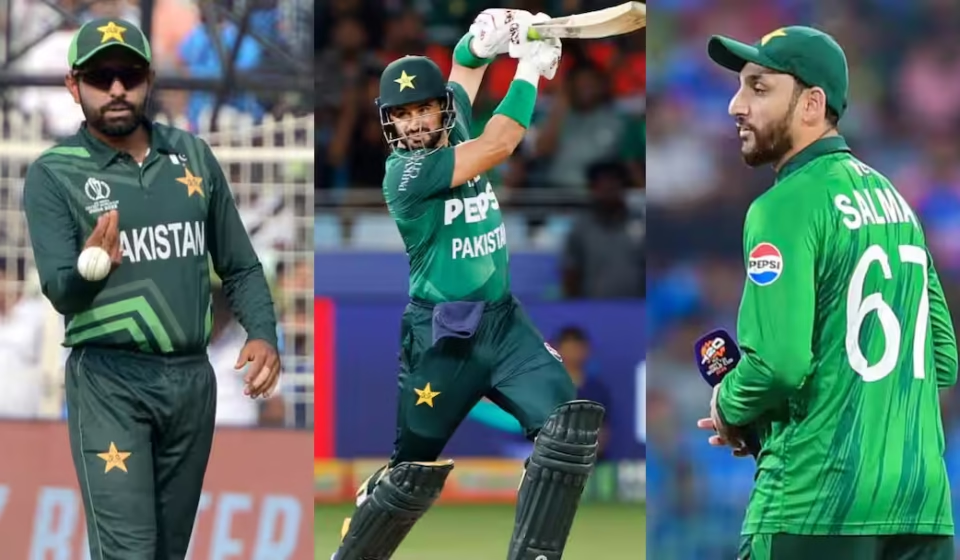

Pakistan cricket has developed an unwanted reputation for changing its leadership at the slightest sign of trouble. The latest decision to hand the T20I captaincy to Sahibzada Farhan, after removing Salman Ali Agha from the role, has once again put the Pakistan Cricket Board’s leadership strategy under the spotlight.
In less than three years, Pakistan have gone through repeated changes in their white-ball leadership. Captains have resigned, been removed, returned to leadership and, in some cases, taken charge only when a regular skipper was unavailable.
The latest change came on October 5, 2026, when the PCB named Sahibzada Farhan as Pakistan’s T20I captain for the three-match home series against Sri Lanka. The decision came just days after Farhan had led Pakistan to a silver medal at the 2026 Asian Games, where India defeated Pakistan in the gold-medal match.
The PCB confirmed that Farhan will lead Pakistan in the T20I series beginning October 9 in Rawalpindi. The second and third matches are scheduled for October 11 and 13.
So how did Pakistan reach this point? The captaincy timeline tells the story.
Babar Azam — the starting point
Babar Azam was Pakistan’s all-format captain when the team entered the 2023 ODI World Cup in India. Pakistan failed to reach the semi-finals, winning only four of their nine group matches.
Following the disappointing campaign, Babar stepped down from captaincy across all three formats in November 2023.
The PCB then split the leadership responsibilities. Shan Masood was appointed Test captain, while Shaheen Shah Afridi was handed the T20I captaincy.
It was the beginning of another period of uncertainty for Pakistan’s T20 setup.
Shaheen Shah Afridi — one series and out
Shaheen’s tenure as T20I captain was extremely short.
He led Pakistan during the five-match T20I series in New Zealand in January 2024. However, Pakistan lost the series 4-1, and the PCB decided to make another major leadership change.
By March 2024, Babar Azam had been restored as Pakistan’s T20I captain.
The decision was particularly notable because Babar had resigned from the position only a few months earlier. Pakistan had therefore moved from Babar to Shaheen and then back to Babar in a very short period.
That quick reversal became one of the clearest examples of the instability surrounding Pakistan’s white-ball leadership.
Babar Azam — the second stint ends
Babar’s second spell did not last long either.
Pakistan’s white-ball captaincy came under renewed pressure during 2024, and Babar eventually resigned again in October.
The PCB confirmed on October 2, 2024, that Babar had stepped down as Pakistan’s white-ball captain. The board said the decision would allow him to focus more heavily on his batting.
This time, Mohammad Rizwan was selected as the new white-ball captain.
But even Rizwan’s T20I leadership would prove complicated.
Mohammad Rizwan — captain, but not always available
Mohammad Rizwan was appointed Pakistan’s white-ball captain in October 2024.
However, the PCB’s workload-management decisions immediately created another unusual situation. Salman Ali Agha, who had been named vice-captain, was given the T20I captaincy for Pakistan’s Zimbabwe tour because Rizwan was rested.
The PCB explicitly confirmed that Salman would lead the T20I side in Zimbabwe while Rizwan remained the official white-ball captain.
That meant Pakistan were already operating with different leadership arrangements within the same white-ball setup.
Salman’s temporary opportunity soon became permanent.
Salman Ali Agha — from stand-in captain to full-time skipper
Salman Ali Agha was appointed Pakistan’s full-time T20I captain in March 2025.
The PCB said the decision was made with the 2025 Asia Cup and 2026 T20 World Cup in mind. Salman had already captained Pakistan during the Zimbabwe T20I series in 2024, making him a familiar option for the selectors.
He subsequently led Pakistan through a lengthy T20I period, including the 2025 Asia Cup and the 2026 T20 World Cup.
The PCB also confirmed Salman as captain for Pakistan’s 2026 T20 World Cup squad.
But after more than a year in charge, another leadership change arrived.
Sahibzada Farhan — the latest name on the list
On October 5, 2026, the PCB announced Sahibzada Farhan as Pakistan’s new T20I captain.
The timing was striking. Farhan had just captained Pakistan at the 2026 Asian Games, where the team reached the final before losing to India and settling for the silver medal.
The PCB rewarded him with the national T20I captaincy for the Sri Lanka series.
At the same time, Salman Ali Agha was dropped from the T20I squad altogether.
The new 15-member squad contains Farhan as captain, while several experienced names, including Babar Azam and Shaheen Shah Afridi, are not part of the T20I group for the Sri Lanka series. Shaheen, however, remains Pakistan’s ODI captain and will lead the side in the upcoming ODI tri-series involving England and Sri Lanka.
Farhan’s appointment therefore represents more than just another captaincy change. It also signals a fresh attempt to build Pakistan’s T20 side around a younger group of players.
Why Pakistan’s captaincy carousel is attracting criticism
Changing captains is not automatically a problem. Cricket teams sometimes need a new leader after poor results, injuries or a change in direction.
The concern with Pakistan is the frequency and timing of those decisions.
Since the 2023 World Cup, Babar has stepped down twice from white-ball leadership, Shaheen’s T20I captaincy lasted only one series, Rizwan took over as white-ball captain before Salman temporarily led the T20I side, and Salman was eventually promoted to permanent T20I captain before being replaced by Farhan.
The result is a team that has repeatedly had to adjust to new leadership styles and different strategic priorities.
It is also worth remembering that some of these changes were format-specific or temporary. Therefore, describing the period simply as “eight different T20I captains” can be misleading. The more accurate story is one of repeated leadership changes and overlapping captaincy arrangements across Pakistan’s T20 setup.
For Pakistan, the challenge now is not just finding another captain. It is giving that captain enough stability to build a team.
Sahibzada Farhan has an opportunity to become that long-term option. He already has recent leadership experience from the Asian Games, and the PCB clearly sees enough potential in him to hand him the national T20I captaincy.
But after years of captaincy changes, Pakistan fans will understandably want more than another short-term experiment.
The three-match Sri Lanka series could therefore be an important first test for Farhan and for the PCB’s latest plan.
Pakistan’s next T20I chapter begins on October 9 in Rawalpindi. Whether Farhan becomes another name in the captaincy carousel or finally brings some stability will be one of the most interesting questions surrounding Pakistan cricket in the months ahead.
Stay tuned with ROKOCRICKET for more Pakistan cricket news, captaincy updates, match analysis and the latest developments from international cricket. Subscribe and keep following the biggest stories from the world of cricket.