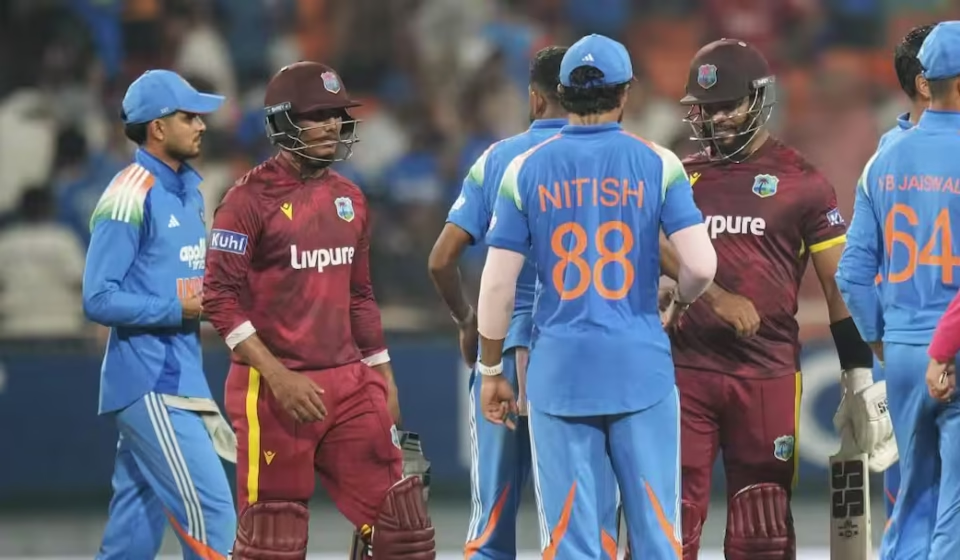

India may have walked away from the ODI series against West Indies with a 2-1 victory, but the series ended with an unwanted ICC punishment for both teams. The International Cricket Council has fined India and West Indies for maintaining slow over-rates during the third and final ODI in New Chandigarh.
The India fined 20% match fee punishment is the bigger of the two sanctions. India were found to be four overs short of their required over-rate after time allowances were taken into consideration. West Indies, meanwhile, were two overs short and were fined 10% of their players’ match fees.
The penalties were imposed by Prakash Bhatt of the Emirates ICC International Panel of Match Referees. Both captains pleaded guilty and accepted the proposed sanctions, meaning there was no need for a formal hearing.
Why India were fined more than West Indies
The calculation is straightforward. Under Article 2.22 of the ICC Code of Conduct for Players and Player Support Personnel, players are fined five per cent of their match fee for every over their team fails to bowl within the allotted time.
India were four overs behind the required rate, resulting in a 20 per cent fine. West Indies were two overs short, which translated into a 10 per cent penalty. The ICC also takes permitted time allowances into account before determining whether a team has committed a slow-over-rate offence.
So, despite the headline-making nature of the punishment, this was not a separate disciplinary case involving individual players. The penalties were directly connected to the teams’ failure to complete their overs within the required timeframe.
The charges were levelled by on-field umpires Jayaraman Madanagopal and Sam Nogajski, along with third umpire Sharfuddoula Ibne Shahid and fourth umpire Virender Sharma.
The timing of the ICC action is also notable because the third ODI was an unusually long and high-scoring contest. The match stretched well beyond the normal duration of an ODI, with West Indies eventually completing a historic chase.
West Indies ended the ODI series with a stunning win
The ICC fine came after one of the most remarkable West Indies victories in recent ODI cricket.
India posted 351/5 after being asked to bat first, setting West Indies a target of 352. On paper, it was a formidable chase. Instead, Shai Hope’s side produced a remarkable batting performance and reached the target in just 48.2 overs.
Hope remained unbeaten on 162, guiding his team to an eight-wicket victory. The result gave West Indies their highest successful run chase in men’s ODI cricket. Their previous best successful chase had been 331/5 against Ireland in 2019.
Hope’s innings also created history. He became the first wicketkeeper-captain to score more than 150 runs in an ODI innings. His unbeaten 162 was also the highest score by a West Indies men’s batter in a successful ODI run chase, surpassing Brian Lara’s 153 against Pakistan in 1993.
For India, the defeat was a disappointing way to finish the series, particularly after producing two extraordinary performances in the opening matches.
India had already secured the series before the final game, having won the first two ODIs. Their second-match performance in Guwahati was particularly spectacular, as they chased down West Indies’ massive 406-run target in only 43.3 overs.
Shubman Gill played one of the defining innings of the series, smashing an unbeaten 223. Rohit Sharma also contributed 101 from 75 balls, while India completed the second-highest successful run chase in ODI history.
The opening ODI had also belonged to India’s top order. Virat Kohli and Shubman Gill both scored centuries as India comfortably chased West Indies’ target and won the match by eight wickets. Kohli’s hundred also took him to the landmark of 15,000 ODI runs, making him only the second player after Sachin Tendulkar to reach that figure.
A costly reminder for India’s bowling unit
While the 20 per cent fine is not going to change the outcome of the series, the slow-over-rate issue is something India will want to address.
With the 2027 ODI World Cup approaching, maintaining discipline with time management will remain important. Long innings, frequent bowling changes, injuries, reviews and changes in field settings can all make it difficult for a side to stay within the required over-rate, but teams are still expected to manage those factors effectively.
The third ODI provided a perfect example of how quickly a match can become difficult to control. India scored 351, West Indies launched a record chase, and the game featured extended periods of pressure on both bowling attacks.
The ICC’s decision also underlines that over-rate regulations apply regardless of the result. India had already won the series 2-0 before the final match, but that did not prevent the governing body from imposing a financial penalty after the required over-rate was missed.
West Indies were fined as well, although their 10 per cent penalty was half of India’s because they were only two overs short.
What happens next for India and West Indies?
There is little time for either side to dwell on the ICC sanctions. The two teams are now set to switch formats for a five-match T20I series, beginning on October 6 in Lucknow. The remaining matches are scheduled for Ranchi, Indore, Hyderabad and Bengaluru.
India will therefore enter the T20I series with plenty of positives from the ODI leg despite the final-match defeat. The performances of Gill, Rohit and Kohli provided plenty of batting confidence, while the series also gave India another opportunity to assess combinations ahead of the 2027 World Cup cycle.
For West Indies, the final ODI victory could provide an even bigger boost. Chasing 352 against India and doing so with only two wickets down is not an ordinary result. Hope’s unbeaten 162 has given the visitors a memorable finish to the ODI leg of the tour.
Still, the ICC’s slow-over-rate punishment means both teams have something to clean up before moving on.
For India, the headline is simple: India fined 20% match fee after falling four overs short of the required rate. West Indies were fined 10 per cent after being two overs behind.
The financial penalties will eventually become a footnote to the series, but the incident serves as another reminder that modern international cricket is becoming increasingly strict about time management.
India won the series 2-1, but West Indies ensured the final word belonged to them on the field. Now the attention turns to the T20I battle, where both sides will look to start fresh.
Stay tuned with ROKOCRICKET for the latest cricket news, ICC updates, match reports and major developments. Subscribe for more updates and let us know in the comments: should the ICC make slow-over-rate penalties even stricter in international cricket?
Related Posts: