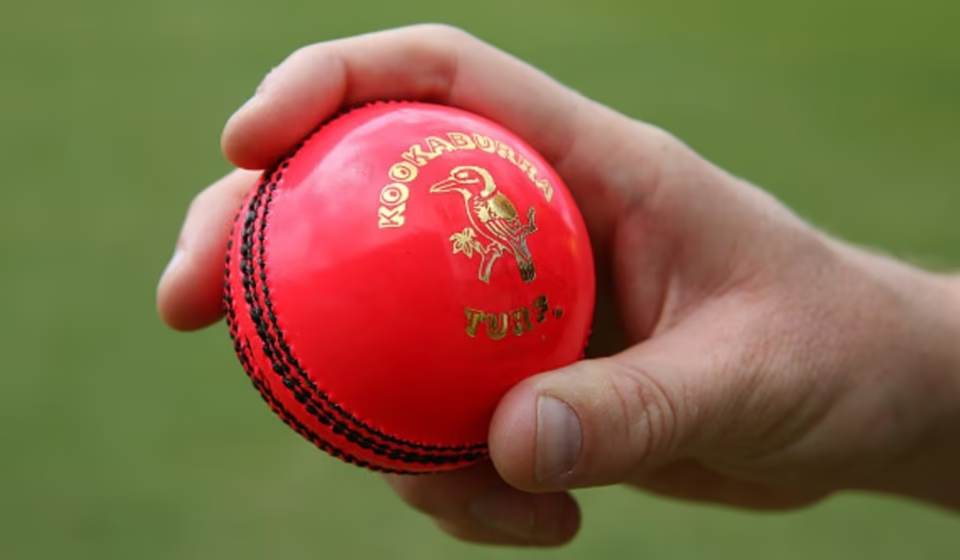
ICC changes cricket rules: pink ball allowed in day Tests, new time-wasting penalty and more

The International Cricket Council has introduced a fresh set of playing-condition changes, and one of the biggest developments could completely change how some Test matches are played.
From October 1, 2026, international series starting on or after that date will come under the updated playing conditions. The changes cover Test, ODI and T20I cricket and include new provisions around pink balls, time-wasting, overthrows, women’s cricket balls and the final over of a day’s Test play. Existing series that had already started before October 1 continue under the previous regulations.
The headline change is particularly interesting for Test cricket: pink balls can now be used in daytime Tests as a trial, provided both teams agree before the match begins.
Pink ball can now be used in a daytime Test
Until now, pink-ball Tests have generally been associated with day-night cricket. The ICC’s new playing conditions open the door for something different.
A Test can now be played with a pink ball during normal daytime hours if both teams agree to the arrangement before the start of the match. The purpose is straightforward: reduce the amount of play lost because of bad light.
The decision, however, is not something teams can change during the match. Once both sides have agreed to use the pink ball, it must remain the ball for the duration of the Test. Similarly, a match cannot begin with a red ball and then switch to a pink ball after play has started.
That could become particularly relevant at venues where fading light regularly affects the final part of the day’s scheduled play.
It also gives cricket boards another option when planning Test matches. Instead of relying entirely on floodlights for a day-night Test, the pink ball could potentially be used during a conventional daytime schedule to keep the game moving for longer when visibility becomes an issue.
Could India use the pink ball against Australia?
This is where the new rule could become particularly interesting for Indian cricket fans.
The BCCI has already confirmed India’s five-Test home series against Australia for early 2027. The third Test is scheduled for February 11-15 in Guwahati, with play beginning at 9:00 AM IST. The other Tests are scheduled for Nagpur, Chennai, Ranchi and Ahmedabad.
The new ICC rule means a pink ball is now an option if both boards agree before the Test.
But it is important not to treat that as confirmation that India will play a pink-ball Test in Guwahati. There has been no official announcement that the third Test will use a pink ball. The rule simply gives the teams the option.
The complete BGT schedule announced by the BCCI is:
| Test | Date | Venue | Start time |
|---|---|---|---|
| 1st Test | January 21-25, 2027 | Nagpur | 9:30 AM IST |
| 2nd Test | January 29-February 2, 2027 | Chennai | 9:30 AM IST |
| 3rd Test | February 11-15, 2027 | Guwahati | 9:00 AM IST |
| 4th Test | February 19-23, 2027 | Ranchi | 9:30 AM IST |
| 5th Test | February 27-March 3, 2027 | Ahmedabad | 9:30 AM IST |
So, for now, the Guwahati Test should be viewed as a possible candidate for the new rule, not a confirmed pink-ball Test.
Batters can now cost their team five runs for wasting time
Another major change targets slow batters.
Under the revised playing conditions, a batter who is not ready to face the next delivery within the prescribed time will receive a warning for the first offence. A second offence brings a final warning.
If the batter commits another offence, the fielding team receives five penalty runs. The five-run penalty can also apply to every subsequent offence, while repeated breaches may lead to action under the ICC Code of Conduct.
The change is designed to keep international cricket moving and discourage unnecessary delays between deliveries.
For a batter, that means preparation time will need to be managed much more carefully. A few seconds might not sound significant, but in a close Test, ODI or T20I, five penalty runs can have a real impact on the score.
ICC clears up the confusion around overthrows
The new regulations also bring greater clarity to one of cricket’s trickier areas: overthrows.
An overthrow will now specifically involve an attempt to direct the ball towards the stumps, either to prevent runs or to attempt a run-out.
A simple misfield does not automatically become an overthrow. If a fielder is attempting to stop the ball or pass it to another fielder and the ball escapes, that situation is not classified as an overthrow under the clarified regulation.
This clarification should make the decision-making process easier for umpires and reduce confusion over when additional runs should be classified as overthrows.
A wicket will not automatically end the final over of the day
There is another interesting Test-specific change.
Previously, if a wicket fell during the final over of the scheduled day’s play, the day’s action could effectively end even if balls remained in the over. Under the revised playing conditions, play will not automatically stop simply because a wicket falls.
If conditions remain suitable, the remaining deliveries of that over can be completed.
The ICC says the change is logical because the unfinished deliveries would otherwise have to be bowled at the start of the following day’s play anyway. Completing the over also gives the fielding side the immediate opportunity to take advantage of the new batter.
More changes across ODI and T20I cricket
The changes are not limited to Test cricket.
The ICC has also permanently added the leg-side wide trial to the ODI and T20I playing conditions. The provision was originally trialled to account for situations where the batter moves around before or during the delivery.
T20I innings intervals have also been standardised at 15 minutes, although that can be reduced to a minimum of 10 minutes when playing time has been lost.
Head coaches or their designated representatives can also enter the field during drinks intervals in ODIs and T20Is, bringing the men’s playing conditions into line with the relevant women’s provisions.
Women’s cricket also gets new ball specifications
The ICC has introduced tighter tolerances for the size and weight of balls used in women’s international cricket.
The aim is to establish clearer and more distinct specifications for men’s, women’s and junior cricket rather than allowing manufacturers to use the same ball specifications across categories.
This may not attract as much attention as the pink-ball Test change, but it is an important standardisation measure for the women’s game.
Why these changes matter
The latest ICC amendments are essentially aimed at three areas: keeping cricket moving, reducing lost playing time and removing uncertainty from the Laws.
The pink-ball trial could be the most noticeable change in Test cricket because it gives teams another way to deal with bad light. At the same time, the time-wasting penalty puts greater responsibility on batters to be ready, while the overthrow clarification should make some on-field decisions easier.
For India, the new rule could become particularly interesting during the 2027 Border-Gavaskar Trophy, especially with a February Test scheduled in Guwahati. But whether India and Australia actually choose a pink ball will depend on an agreement between the two sides before that Test begins.
For now, one thing is certain: international cricket has entered another phase of rule changes, and some of them could have a visible impact on matches very soon.
Stay tuned with ROKOCRICKET for more cricket rules, India cricket updates, Test news, match schedules and the latest developments from around the world. Don’t forget to subscribe and keep following the game.