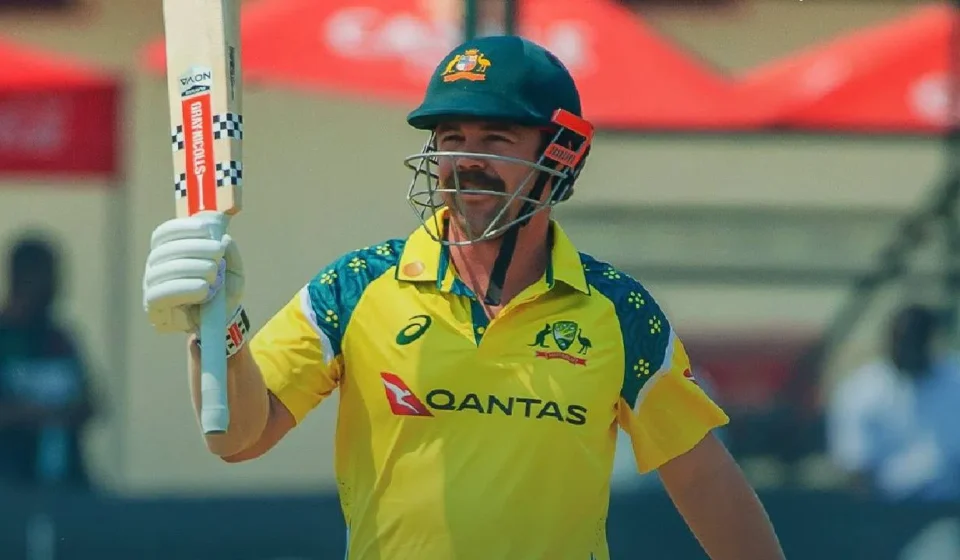

Travis Head has finally rediscovered his destructive touch. After a long wait for a major international innings, the Australian opener produced a breathtaking 112 off 84 balls against Zimbabwe in the second ODI at Harare Sports Club. His 75-ball century not only powered Australia to 356/6 but also broke a record that had been set by his own teammate Matt Renshaw just three days earlier.
Travis Head has reminded everyone why he is considered one of the most dangerous white-ball batters in world cricket.
The Australian opener produced a sensational innings in the second ODI against Zimbabwe at Harare Sports Club on Friday, September 18. Head smashed 112 runs from just 84 deliveries, including 15 fours and three sixes, and reached his century in only 75 balls.
It was not just another hundred for the left-hander. The innings came after a difficult period for Head and ended a long wait for a major international century. More importantly, he broke a record that had been created by Australia’s own Matt Renshaw only 72 hours earlier.
Australia eventually finished their 50 overs on 356/6, their highest ODI total against Zimbabwe.
Head turns the clock back to his best
Head walked out with Mitchell Marsh and immediately looked in the mood to attack.
Australia’s opening pair put together a powerful 130-run partnership, with Marsh contributing 53 from 63 balls. But while Marsh took his time to settle, Head went after the Zimbabwe attack from the beginning.
The Australian opener reached his half-century from only 32 balls. Once he crossed fifty, there was little sign of him slowing down.
Head continued finding gaps, clearing the boundary and putting pressure on the Zimbabwe bowlers. He brought up his century from 75 deliveries, making it his third-fastest ODI hundred. His fastest remains the 59-ball century against New Zealand at the 2023 ODI World Cup, while his 70-ball hundred against Pakistan in 2022 is his second-fastest.
Eventually, Head’s entertaining innings ended on 112 from 84 balls. He attempted another big shot but was caught by substitute fielder Ryan Burl off Wessly Madhevere.
By then, however, the damage had already been done.
A record broken within just 72 hours
Perhaps the most interesting part of Head’s century was the timing.
Australia had only played their first ODI of the series three days earlier. In that match, Matt Renshaw scored his maiden ODI century, making 109 from 94 balls.
Renshaw’s century was particularly significant because Australia had not had an ODI hundred against Zimbabwe since 2004. His innings helped Australia reach 294/8 before Nathan Ellis’ five-wicket haul helped seal a 59-run victory.
Renshaw’s 86-ball route to three figures was the fastest ODI century by an Australian against Zimbabwe.
Then came Head.
The explosive opener needed only 75 balls to reach three figures, taking the record away from his teammate almost immediately.
So, in the space of just 72 hours, the record changed hands twice.
That is quite a way for Australia’s ODI series in Zimbabwe to begin.
Head’s 20th international century
The century was also another important milestone in Head’s international career.
The Zimbabwe innings was his eighth ODI century and his 20th international hundred overall. His previous ODI century had come in September 2024 against England, while his most recent international hundred had come during the 2025-26 Ashes. Cricket Australia described this as his first century since that Ashes campaign.
Head has now scored eight ODI hundreds and has established himself as one of Australia’s most destructive top-order players.
His ODI numbers are impressive as well. After this innings, he moved beyond 3,100 ODI runs, with his career strike rate remaining above 100.
That combination of volume and scoring speed is what makes Head such a difficult batter to contain once he gets through the opening phase.
From a difficult run to a statement innings
The century was particularly timely because Head had not been able to convert his starts into big scores in recent matches.
He was dismissed for just four runs in the first ODI against Zimbabwe, while his recent red-ball outings against Bangladesh had also failed to produce the kind of innings expected from him.
His return to form therefore could not have been more emphatic.
Instead of trying to rebuild his confidence cautiously, Head did what Head generally does when he is at his best — attack.
He used his strong hitting areas, punished loose deliveries and kept the scoreboard moving at a rapid rate.
That approach also allowed Australia to establish a strong platform for the middle order.
Australia post 356 — their highest ODI total against Zimbabwe
Head’s century was the headline, but Australia had contributions throughout the batting order.
Mitchell Marsh scored 53 from 63 balls, while Cooper Connolly continued his excellent recent run by making 78. Youngster Ollie Peake then provided a late burst, smashing an unbeaten 41 from only 18 balls, including three sixes in the final over.
Australia eventually reached 356/6 from their 50 overs.
That became their highest ODI total against Zimbabwe, surpassing the previous Australian mark of 350, which was recorded in 2014.
It was also another sign of the depth Australia are trying to build in their batting group ahead of the next ODI World Cup cycle.
The current Zimbabwe series is part of an important period for Australia’s ODI setup. With several experienced players no longer part of the team’s long-term plans, younger players such as Connolly, Renshaw and Peake are getting valuable opportunities alongside established stars like Head and Marsh.
The unbeaten Head century record
There is another fascinating statistic attached to Head’s 20 international centuries.
Before this match, Australia had never lost an international match in which Head scored a century. His previous 19 hundreds had all come in matches Australia did not lose.
That remarkable record is now extended to his 20th century as well, although the full match result against Zimbabwe is naturally the final measure of whether that streak continues.
For a player who can change the direction of a match in a matter of overs, that record adds another interesting layer to Head’s growing international legacy.
And perhaps the biggest takeaway is simple: when Travis Head starts seeing the ball this well, bowling attacks have very little room for error.
What next for Travis Head?
Head’s 112 could prove important beyond this one ODI.
Australia have a packed international schedule ahead, and the team will need their senior batters firing consistently. A confident Head at the top of the order gives Australia an entirely different attacking dimension.
The second ODI also showed that Australia’s batting stocks are not dependent on one player. Marsh contributed a half-century, Connolly continued his impressive form and Peake produced a remarkable late cameo.
But Head was the man who set the tone.
From four runs in the first ODI to 112 in the second, his turnaround was almost as dramatic as his batting itself.
And doing it by breaking a record that had been set by Renshaw just three days earlier made the story even more entertaining.
For now, Travis Head is back among the runs — and he has done it in typically explosive fashion.
Stay tuned with ROKOCRICKET for more cricket records, breaking news, match updates and stories from around the world. If you enjoyed this story, subscribe and keep following ROKOCRICKET for the latest cricket action.