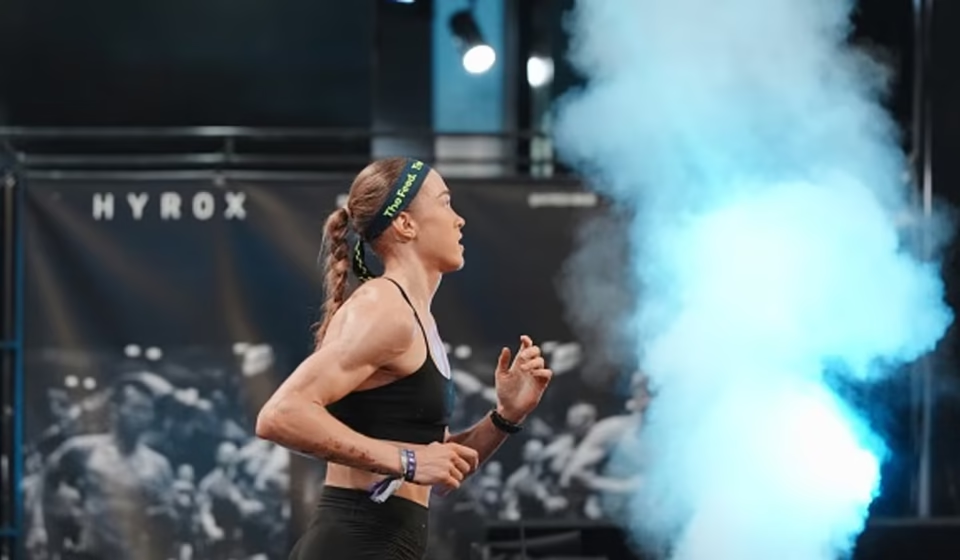
HYROX Joanna Wietrzyk Incident: 5 Big Changes After Beijing Race Controversy, Organisers Apologise and Rewrite Rules

The HYROX Joanna Wietrzyk incident has forced one of the world’s fastest-growing fitness racing organisations to rethink how it handles medical and hygiene problems during competition.
Australian athlete Joanna Wietrzyk, the women’s HYROX world record holder, suffered sudden bowel incontinence during the HYROX Beijing Pro Women’s race on September 12. Despite the incident, she continued competing and eventually won the race in 1:01:23. The episode later triggered a major debate about athlete welfare, hygiene and the responsibility of race officials.
Now HYROX has apologised, acknowledged that its officials should have intervened during the race and introduced new procedures designed to prevent a similar situation from happening again.
What happened to Joanna Wietrzyk during the HYROX Beijing race?
Wietrzyk entered the Beijing event as one of the biggest names in women’s HYROX. She currently holds the women’s world record with a time of 54:25, set in Warsaw in April 2026.
During the September 12 race at Beijing’s National Speed Skating Oval, however, she suffered a sudden bout of diarrhoea and lost control of her bowels.
Instead of stopping, Wietrzyk continued through the demanding HYROX course. The competition combines running with functional exercises, meaning athletes repeatedly move between running sections and stations involving movements such as sled work, rowing, lunges and burpee broad jumps.
The problem became particularly significant because competitors use shared areas and equipment during a HYROX event. Images and videos that later circulated online showed that Wietrzyk continued racing despite the incident.
According to reports, she completed the course and won the women’s Pro event with a time of 61 minutes and 23 seconds.
That result, however, quickly became secondary to questions about why the race was allowed to continue without officials removing her from the competition.
HYROX admits it made a mistake
The biggest development came from HYROX co-founder Moritz Fürste, the former Olympic field hockey champion.
Fürste publicly apologised over how the situation was handled and accepted responsibility for the organisation’s failure to react quickly enough.
He said HYROX “made a mistake by not reacting immediately during the race” and acknowledged that the organisation should have been prepared to deal with such a situation. He also confirmed that changes to event procedures and the rulebook had already begun.
That admission is important because the issue was not simply about what happened to one athlete. The bigger question was what should happen when a competitor experiences a medical problem that could potentially affect other athletes sharing the course.
HYROX said its existing medical and bio-contamination procedures were not clearly applied during the Beijing race. That gap has now led to a change in the rules.
What are the new HYROX rules?
The updated rules give race officials clearer authority to remove an athlete when bodily fluids create a welfare or contamination risk.
According to the newly reported rulebook addition, if a racer’s blood, vomit, urine or faeces creates a welfare or contamination risk to themselves or other competitors, the Race Director can withdraw that athlete from the competition on medical grounds.
Such a withdrawal would be recorded as Did Not Finish (DNF).
This is a significant change because it removes some of the uncertainty officials faced in Beijing.
In an intense fitness race, athletes are naturally encouraged to push through fatigue, pain and discomfort. But there is an important difference between an athlete deciding to fight through ordinary physical discomfort and a situation where continuing could potentially affect the health or safety of other competitors.
The new wording gives race officials a much clearer line to follow.
HYROX cleaned the affected area after the race
HYROX China and HYROX World also addressed what happened to the venue after the incident.
Reports said the affected racing lane was isolated following the event. Contaminated equipment was removed, while the affected area and track were cleaned and disinfected before competition resumed.
The venue’s carpet was also reportedly replaced overnight.
HYROX had previously acknowledged that procedures relating to bio-contamination and medical situations already existed, but the Beijing incident exposed a weakness in how those procedures were applied during live competition.
For a sport built around athletes repeatedly using the same running lanes and workout stations, that distinction matters.
HYROX describes its format as eight rounds of a 1km run followed by a functional workout, creating a course where athletes constantly share the same competition environment.
Joanna Wietrzyk also became the target of online abuse
The incident did not stop at criticism of the organisers.
After Wietrzyk’s identity became widely known online, some social-media users directed abusive comments and threats towards the Australian athlete.
HYROX responded by warning that anyone making threats of violence or encouraging harm against Wietrzyk would face a permanent ban from HYROX events. The organisation said there was no place in its community for threats against athletes, whether they were made publicly, through comments or via direct messages.
That distinction is worth making.
There can be legitimate questions about competition safety, medical decisions and event procedures. But criticism of an organisation’s handling of an incident is very different from targeting an athlete with threats or personal abuse.
Wietrzyk’s coach, Chris Bayens, also defended the athlete and criticised the personal attacks directed at her, arguing that the situation happened unexpectedly and that decisions made under the pressure of competition should be viewed in that context.
Why the HYROX incident matters beyond one race
The Beijing episode has raised a broader question for endurance and fitness sports: How far should an athlete be allowed to push through a medical problem before officials are required to intervene?
There is no doubt that elite athletes regularly compete through enormous physical discomfort. That resilience is part of what makes endurance sport so compelling.
But shared-course events create another responsibility.
When a medical incident potentially affects equipment, flooring or areas used by other competitors, the decision is no longer solely about the individual athlete. Race directors also have to consider everyone else competing on the same course.
That is exactly the issue HYROX’s new rules appear designed to address.
For Wietrzyk, the Beijing race will probably be remembered for reasons very different from her world-record performances. For HYROX, meanwhile, the incident has become a lesson in how quickly rules need to evolve as the sport grows.
And HYROX is continuing to expand. Its official event calendar currently includes races across multiple countries, including Mumbai, Salt Lake City, Oslo and Rome in September 2026.
The organisation will therefore have to make sure the lessons from Beijing are applied consistently at every venue.
For now, the clearest message from HYROX is that officials should have acted sooner — and that the rules have now been changed to make that responsibility clearer.
Stay tuned with ROKOCRICKET for more breaking sports news, unusual moments and stories from the world of athletics and fitness. And if you enjoy our coverage, don’t forget to subscribe and share your thoughts in the comments.