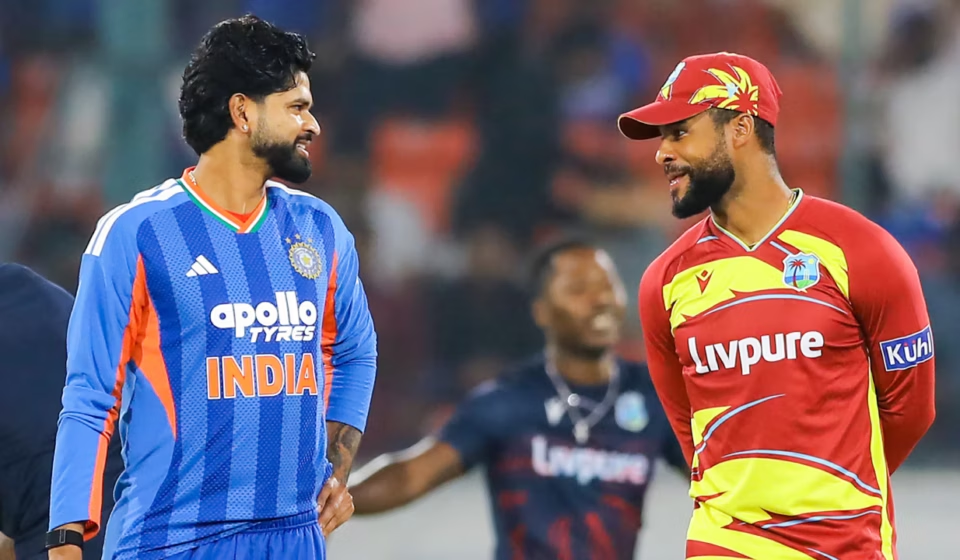

West Indies cricket is facing a major financial debate after Cricket West Indies (CWI) CEO Chris Dehring claimed that his board would receive no direct revenue from the ongoing bilateral series against India, despite the tour reportedly being capable of generating between $20 million and $30 million.
Dehring’s comments have once again brought the economics of international cricket into focus, particularly the growing gap between India and other cricket-playing nations. While matches involving India attract enormous television audiences, sponsorship deals and commercial interest, the financial benefits of a bilateral series largely depend on which country hosts the matches.
The controversy has raised an important question: Does the current cricket revenue model give smaller boards a fair opportunity to compete financially with India and other wealthier cricket nations?
According to Dehring, the system that governs bilateral cricket revenues has placed West Indies cricket at a significant disadvantage, contributing to the financial challenges that have troubled the Caribbean game for years.
Chris Dehring questions the India-West Indies series revenue model
Speaking on Wisden’s The Scoop, Dehring criticised the existing arrangement under which the host board generally controls the commercial revenues generated by a bilateral series.
He pointed to the ongoing India-West Indies white-ball series, arguing that the Caribbean board would not receive a share of the substantial earnings generated by matches played on Indian soil.
“West Indies cricket receives nothing in this case, because the series is being played in India,” Dehring said, referring to the reported potential revenue of $20 million to $30 million.
His comments highlight the commercial reality of modern international cricket. India has one of the world’s largest cricket audiences, making its home matches particularly attractive to broadcasters, advertisers and sponsors. Consequently, a series played in India can generate significantly more money than a comparable tour hosted in the Caribbean.
For Cricket West Indies, the concern is not simply the earnings from one particular series. It is the wider financial imbalance between boards that can generate enormous commercial returns from their domestic markets and those that operate in smaller economies.
The reported $20 million to $30 million figure represents the potential commercial value discussed in connection with the series, rather than a confirmed final profit or an independently verified accounting statement.
The 1997 decision that changed bilateral cricket
Dehring believes the roots of the problem can be traced back to a major change in international cricket’s financial arrangements in 1997.
Before that shift, West Indies could earn touring fees when visiting other countries. According to Dehring, those payments were sometimes worth more than the Caribbean board could generate by hosting international matches at home.
That arrangement helped West Indies benefit financially from its reputation as one of the strongest and most entertaining teams in world cricket.
However, the financial model changed, giving host boards greater control over the revenues generated by international series played in their countries.
Dehring recalled that Cricket West Indies was heavily outvoted when the matter was discussed among ICC member countries.
“It was palpably unfair. We were outvoted nine to one by the ICC member countries,” he said, describing the decision as a turning point for Caribbean cricket.
He argued that the new system allowed countries with huge populations and strong commercial markets to retain the benefits of their domestic cricket audiences, while West Indies had to depend on the much smaller markets across its island nations.
His criticism is rooted in a fundamental difference between cricket boards. India can draw on a vast domestic audience, whereas West Indies represents several Caribbean territories with comparatively small populations and limited commercial markets.
As a result, the same international cricket product can generate dramatically different revenues depending on where it is staged.
Why India earns so much more from international cricket
India’s financial strength in cricket is closely linked to its enormous fan base, broadcasting market and sponsorship opportunities.
Matches featuring the Indian team attract millions of viewers, creating valuable opportunities for television networks, digital platforms and commercial partners. Advertisers are willing to invest heavily because cricket provides access to a large and engaged audience.
The Indian cricket board, the Board of Control for Cricket in India (BCCI), benefits from this commercial demand through media rights, sponsorship agreements and the organisation of international matches at home.
India’s position is also reflected in the ICC’s revenue distribution. The distribution model approved for the 2024–2027 cycle allocates the BCCI approximately 38.5 per cent of the ICC’s annual net distribution, making it the largest recipient. West Indies receives a much smaller share, reported at around five per cent.
These ICC distributions are separate from the money earned by hosting a bilateral series. A board’s ICC allocation does not automatically give it a share of the commercial income from every series played by another country.
That distinction is central to Dehring’s argument. Even when West Indies participates in a commercially valuable series, the Caribbean board does not necessarily receive a direct portion of the income generated in the host country.
West Indies cricket’s financial problems go beyond one series
The debate comes at a difficult time for West Indies cricket, which has struggled to maintain its former dominance in international competition.
The Caribbean side once ruled world cricket, producing legendary players and winning major international titles. However, the modern game has brought new financial and organisational challenges.
Cricket West Indies has faced continuing pressure over player payments, contracts and the relationship between international cricket and lucrative franchise T20 leagues.
Several Caribbean players have built successful careers in franchise competitions around the world. These tournaments can offer attractive financial rewards, creating difficult choices for players who must balance international commitments with opportunities in domestic and overseas leagues.
When a national board struggles to compete financially with franchise tournaments, retaining leading players and maintaining consistent team availability becomes more complicated.
Financial pressure can also affect investment in coaching, grassroots programmes, domestic competitions and facilities. Those areas are essential for developing the next generation of international cricketers.
Dehring’s criticism therefore reflects a broader concern about the long-term sustainability of West Indies cricket, rather than simply the outcome of a single bilateral series.
Pay cuts and player dissatisfaction add to the pressure
Cricket West Indies has also faced difficult decisions over player compensation and contractual arrangements amid its financial problems.
Pay disputes have been a recurring source of tension between the board and players, with concerns about earnings and the attractiveness of international commitments becoming increasingly important in an era of expanding T20 leagues.
For a cricket board operating across multiple Caribbean territories, generating enough money to support international teams, domestic competitions and development programmes is a significant challenge.
The concern is that a sustained lack of financial resources could make it harder for West Indies to retain talent, improve infrastructure and compete consistently against the strongest international teams.
However, the financial challenges facing the board cannot be attributed to the bilateral revenue model alone. Governance, commercial strategy, player relations, performance and investment decisions also influence the health of a cricketing organisation.
A lasting solution would therefore require more than a change in how series revenues are distributed.
Could international cricket introduce a fairer revenue-sharing system?
Dehring’s remarks have renewed the debate over whether international cricket needs a more balanced financial structure.
One possible approach would involve greater revenue-sharing arrangements for bilateral series, particularly when visiting teams contribute significantly to the commercial appeal of a tour.
Another option could be stronger financial support for smaller boards through existing ICC distributions, development funding or other collective commercial arrangements.
Supporters of reform may argue that international cricket needs competitive teams across all major regions to preserve its global appeal. A stronger West Indies side would benefit not only Caribbean supporters but also broadcasters, sponsors and fans worldwide.
At the same time, any proposed change would need to consider the commercial risks taken by host boards, which organise matches, manage venues and negotiate broadcasting and sponsorship agreements.
India’s commercial success is not simply the result of hosting visiting teams. It is also built on years of audience growth, investment and a domestic market that attracts substantial commercial interest.
The challenge for the ICC and its members is to find a balance between rewarding boards for generating revenue and ensuring that smaller cricket nations have sufficient resources to remain competitive.
Whether a new model will emerge remains uncertain, but Dehring’s comments have made one issue clear: financial inequality is becoming an increasingly important question for the future of international cricket.
What happens next for West Indies cricket?
The India-West Indies series has once again demonstrated the commercial power of Indian cricket and the challenges faced by smaller boards in the international game.
For Cricket West Indies, the priority will be to find sustainable ways to strengthen its finances, support its players and invest in the future of Caribbean cricket. For the wider cricketing community, the debate is about ensuring that international competition remains financially viable beyond the sport’s biggest markets.
A more sustainable system would need to recognise both the commercial value of major cricket markets and the importa