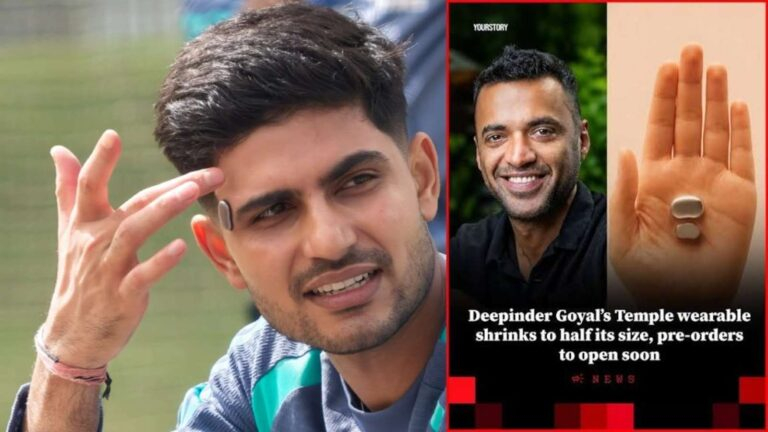
India captain Shubman Gill has reportedly tested Zomato co-founder Deepinder Goyal’s experimental Temple wearable during a training session in Auckland, drawing attention to a new device designed to monitor signals associated with blood flow in the brain. The India batter was preparing for the fourth T20I against New Zealand when he tried the unreleased technology at the nets, according to a report by RevSportz.
Gill was joined during the training session at Eden Park by India Test vice-captain KL Rahul and fast bowler Gurnoor Brar. Reports suggest that Gill was impressed by the initial feedback and data generated by the device, although no detailed assessment of his experience or independent performance results have been made public.
The Shubman Gill Temple wearable trial has attracted interest beyond cricket because the device takes a different approach to fitness tracking. Instead of being worn on the wrist like a conventional smartwatch, Temple is designed to sit against the side of the forehead. Its unusual placement and focus on physiological signals have put it in the spotlight as Goyal prepares for a wider launch.
What is Deepinder Goyal’s Temple wearable?
Temple is an experimental health-monitoring wearable developed by Deepinder Goyal, best known as the co-founder of Zomato. The device is designed to collect signals from tissues and blood vessels around the forehead through a system Goyal calls BrainFlow.
The technology aims to track changes associated with blood flow in the brain under everyday conditions. According to Goyal’s description, the measurements could help researchers and users explore how factors such as posture, physical movement and daily activities influence these signals.
Unlike standard fitness bands, which commonly track metrics such as heart rate, steps, sleep and exercise, Temple focuses on a different area of physiological monitoring. Its forehead-mounted design reflects the company’s attempt to gather data from a location that may provide information beyond the measurements offered by typical consumer wearables.
However, the distinction between collecting physiological signals and establishing what those signals mean is important. Temple’s proposed capabilities should not be confused with a proven method of diagnosing medical conditions or measuring overall brain health. Independent validation, published performance data and further research will be important in determining how useful its measurements are.
Why Shubman Gill’s trial has attracted attention
Gill’s reported experience has brought the device into the cricketing conversation at a time when professional teams increasingly rely on technology to monitor training loads, recovery and physical performance.
Modern cricket involves demanding schedules, frequent travel and repeated high-intensity efforts. Wearable technology can help athletes and support staff collect information about physical activity and recovery, although the usefulness of any device depends on the quality of its measurements and how the data is interpreted.
For a player such as Gill, who leads India in Test and ODI cricket, additional physiological data could be interesting if it eventually offers reliable insights into how the body responds to training and fatigue. Nevertheless, there is currently no publicly established evidence that Temple improves batting performance, prevents injuries or gives cricketers a competitive advantage.
Gill’s reported trial is therefore best viewed as an early test of an emerging technology rather than an endorsement of its effectiveness. More details about the measurements collected during the session, their accuracy and their practical application in professional sport would help establish the device’s potential.
The involvement of other Indian players in the training session also highlights the growing curiosity surrounding technology that moves beyond conventional fitness tracking. Whether Temple eventually finds a place in elite sports will depend on evidence, usability and the value it delivers to athletes.
Temple wearable price, colours and pre-order details
Deepinder Goyal’s Temple wearable is also approaching its first commercial release. The device is expected to be available in six launch colours: True Gold, Rose Gold, Black Mirror, Real Jade, Deep Blue and Purple Funk.
Early-access invitations have reportedly listed the price at around ₹85,000, including lifetime access to the software platform. However, the company has not formally confirmed the final retail price, so prospective buyers should treat that figure as an indication rather than a confirmed price.
Pre-orders for Temple Batch 01 are scheduled to open to the public on November 1, 2026. Goyal has indicated that the first units will be handmade to order, with delivery expected within three months of purchase. Members of the early-access waitlist are expected to receive priority.
The launch will give consumers an opportunity to explore a wearable that focuses on physiological monitoring rather than the familiar features of a smartwatch. Its premium pricing, unusual design and proposed brain-related measurements could make it an interesting option for technology enthusiasts, athletes and people interested in personal health data.
At the same time, Temple faces an important challenge: demonstrating that its measurements provide reliable, meaningful information in real-world conditions. A distinctive design can generate curiosity, but long-term consumer interest will depend on the quality of the data, ease of use and practical benefits.
Can Temple change the future of sports technology?
The reported trial involving Shubman Gill offers a glimpse of how emerging wearable devices could attract interest from professional athletes. Cricket teams already use performance analysis, video technology and physical monitoring to support preparation. Devices that offer additional, dependable physiological information could eventually become part of that wider approach.
However, it is too early to conclude that Temple will become a regular tool in professional cricket. Its value will depend on further testing, independent research and evidence showing whether the information it provides can support meaningful decisions about training or recovery.
For now, Gill’s reported experience has added a prominent sporting name to the conversation surrounding Goyal’s technology. The coming months should provide a clearer picture of how Temple performs outside demonstrations and controlled testing.
Stay tuned to ROKOCRICKET for the latest cricket news, India team updates, technology stories and developments from the world of sports. Subscribe to our updates so you do not miss the stories making headlines.