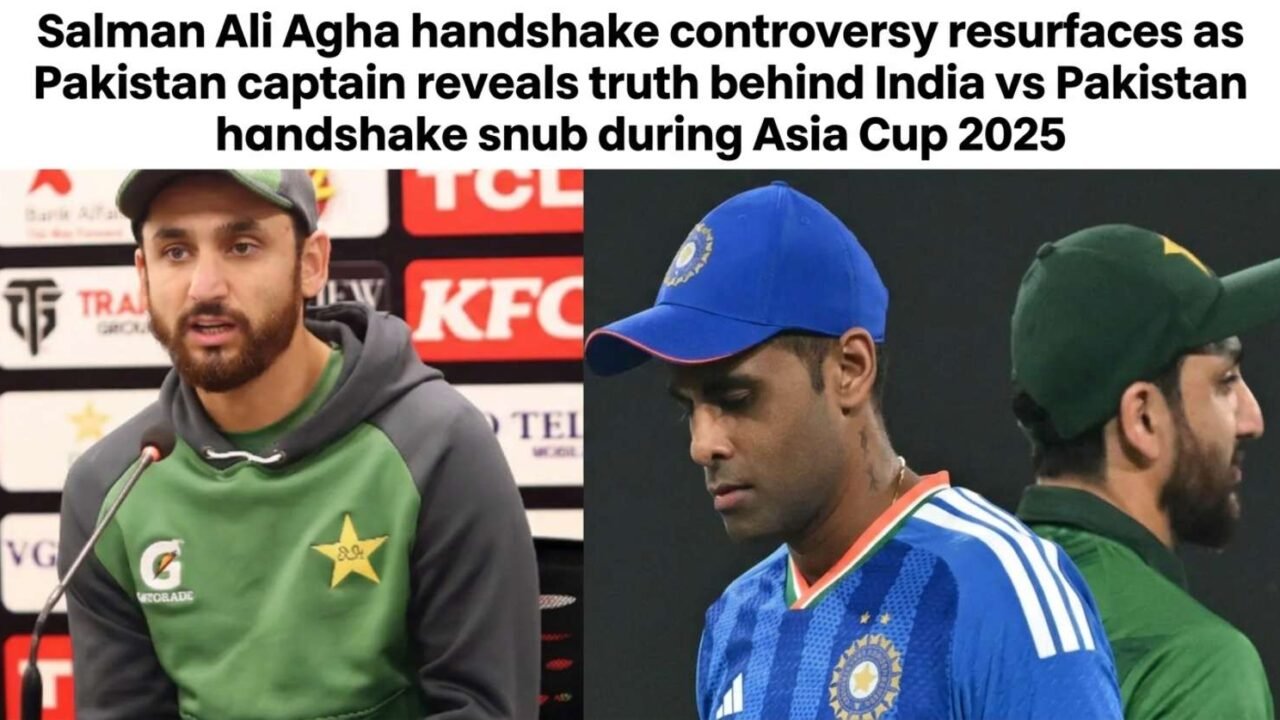



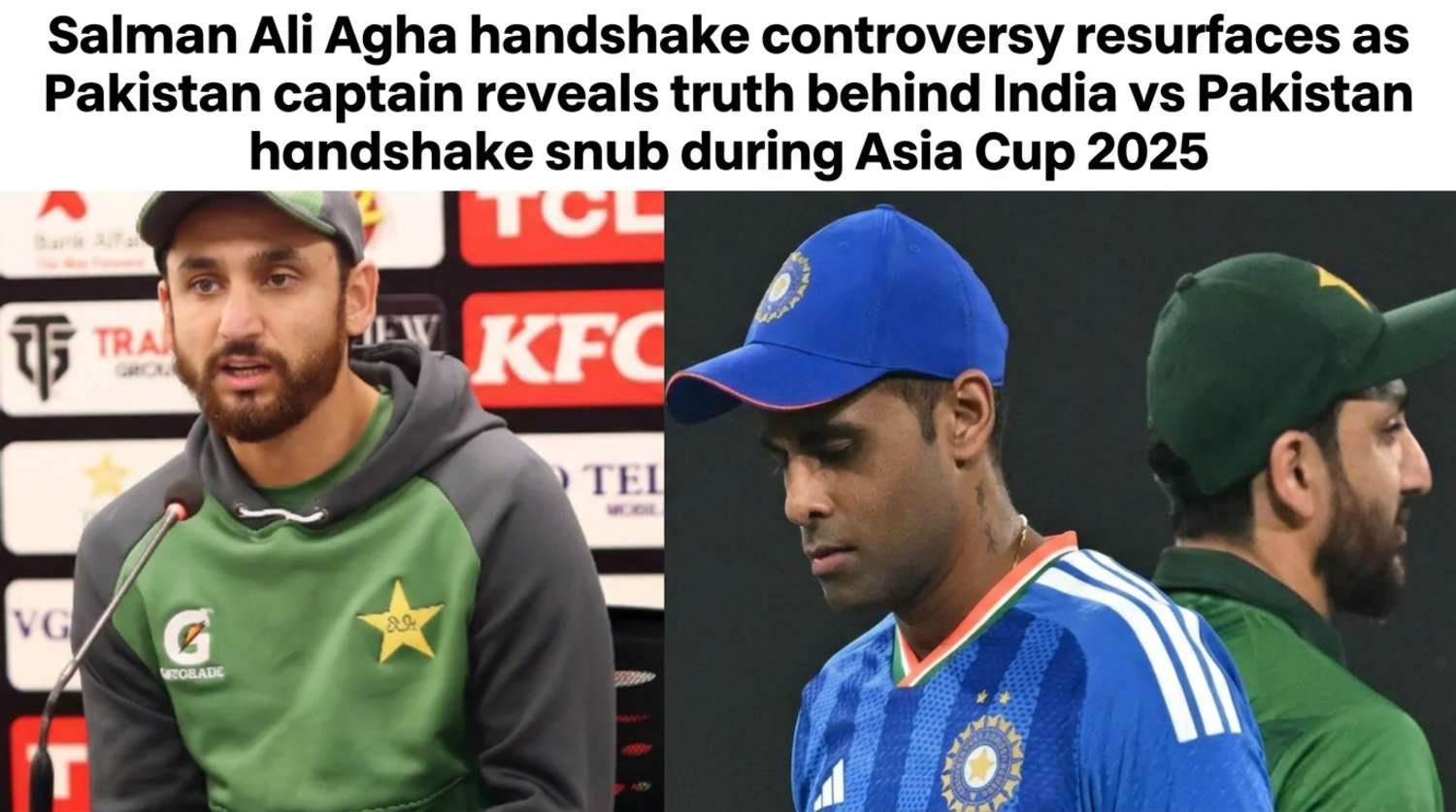
Salman Ali Agha handshake controversy resurfaces as Pakistan captain reveals truth behind India vs Pakistan handshake snub during Asia Cup 2025. Full story inside.
Salman Ali Agha handshake controversy takes center stage again
The Salman Ali Agha handshake controversy is back in the spotlight, and this time, the Pakistan captain has spoken openly about what really happened during the highly debated India vs Pakistan clash in Asia Cup 2025.
What seemed like a simple pre-match ritual turned into a major talking point across the cricketing world. The absence of a handshake between Suryakumar Yadav and Salman Ali Agha wasn’t accidental—it was a deliberate move that reflected deeper tensions beyond the boundary.
-Points to Watch Out
| Key Moment | What Happened | Why It Matters |
|---|---|---|
| Pre-match Toss | No handshake between captains | Signaled political tension |
| Match Referee Warning | Agha was informed earlier | Not a surprise incident |
| Post-match Scene | No handshake again | Reinforced India’s stance |
| Final Ceremony | Trophy not accepted from PCB chief | Diplomatic message |
| Continued Trend | Same approach in T20 World Cup | Not a one-time act |
What Salman Ali Agha actually revealed
Breaking his silence on an ARY podcast, Agha clarified that the Salman Ali Agha handshake controversy was not as sudden as it appeared.
He revealed that interactions before the tournament were completely normal. Players from both teams shook hands during press conferences and even during the trophy photoshoot.
However, things changed dramatically during match day.
Agha said he was taken aside by the match referee before the toss and informed that India would not participate in the handshake tradition.
“If there’s no handshake, then so be it. It’s not like I was desperate,” Agha stated calmly.
This statement has now become central to the Salman Ali Agha handshake controversy, highlighting that Pakistan was prepared—but not entirely convinced by the move.
Why India refused the handshake
India’s decision, led by captain Suryakumar Yadav, was not just about cricket. It came in the aftermath of the Pahalgam terror attack, which resulted in the loss of 26 lives.
The gesture was widely seen as a mark of solidarity with the victims.
Indian players extended this stance beyond the toss:
- No handshake before matches
- No handshake after matches
- Maintained the approach in all three games, including the final
India won all three encounters, but the focus remained on the symbolic silence rather than the victories.
Agha’s concern: Role model responsibility
While Agha accepted the situation, he didn’t fully agree with it.
He emphasized that cricketers are role models and their actions influence younger generations.
“Children will pick this up. If it happens in club cricket, it will be because of us,” he explained.
This perspective adds another layer to the Salman Ali Agha handshake controversy, shifting the debate from politics to sportsmanship and influence.
The controversy didn’t stop at the field
The tension escalated further during the post-match ceremony of the Asia Cup final.
India refused to accept the trophy from Mohsin Naqvi, who was also serving as the head of the Pakistan Cricket Board.
This led to:
- Delay in the presentation ceremony
- Trophy not being formally handed over
- Naqvi leaving the venue with the trophy
Despite winning the tournament, India never officially received the trophy—an unusual and unprecedented moment in cricket history.
A pattern, not a one-off incident
The Salman Ali Agha handshake controversy didn’t end with the Asia Cup.
India continued the same no-handshake approach during the T20 World Cup, signaling that this was a consistent policy rather than a one-time reaction.
This consistency indicates:
- A strategic stance
- A message beyond cricket
- A shift in traditional sporting behavior
Public reaction and global debate
The cricketing world remains divided over the Salman Ali Agha handshake controversy.
Supporters of India’s stance say:
- It was a justified symbolic protest
- Sports cannot be separated from real-world issues
- It showed national solidarity
Critics argue:
- Sportsmanship should remain above politics
- Handshakes are a basic sign of respect
- It sets a risky precedent for future matches
Why this controversy matters in modern cricket
The Salman Ali Agha handshake controversy is more than just a moment—it reflects how cricket is evolving in today’s geopolitical environment.
Key takeaways:
- Cricket is no longer isolated from global events
- Player actions carry diplomatic weight
- Symbolic gestures can overshadow performance
This incident may influence how future India-Pakistan matches are approached, both on and off the field.
The Salman Ali Agha handshake controversy continues to spark debate because it sits at the intersection of sports, politics, and personal values.
Agha’s calm yet firm response shows maturity, while India’s stance reflects a strong message.
But one question still remains:
Should sports remain neutral, or is it inevitable for global tensions to enter the field?
💬 Comment your opinion on this post — Do you support India’s decision or believe sportsmanship should come first?