The India vs Palestine U-17 clash in the AFC U-17 Asian Cup 2027 qualifiers has sparked a major controversy after a Palestinian player was accused of making an alleged racist gesture towards Indian captain Dalalmuon Gangte. A video of the incident has gone viral on social media, triggering strong reactions from Indian football fans and the wider sporting community.
The controversy overshadowed an important match in Kuala Lumpur, Malaysia, where India eventually secured an impressive 4-1 victory over Palestine on November 17, 2026.
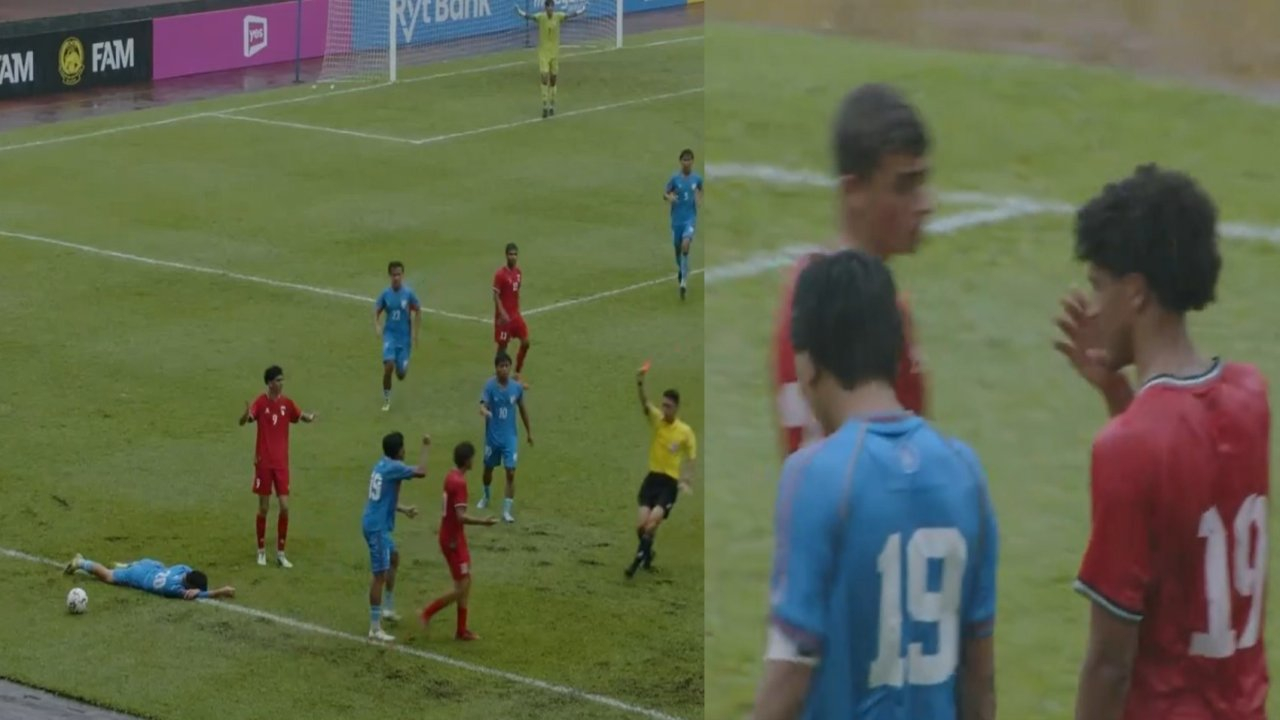
The incident attracted attention after a Palestine player wearing jersey No. 19 appeared to wave his hand near his nose while walking alongside Gangte. The gesture was widely interpreted as an attempt to suggest that the Indian player smelled bad, echoing a discriminatory stereotype frequently directed at people from India and South Asia.
Indian supporters expressed their anger online, with several demanding that the Asian Football Confederation (AFC) investigate the incident and take appropriate action if misconduct is established.
The controversy became even more significant because the match had already witnessed an aggressive challenge, a straight red card and a temporary interruption caused by heavy rain.
Palestine player faces criticism after controversial incident
The incident involving Palestine’s No. 19 quickly became one of the most discussed moments of the match. In the footage circulating online, the player appears to make a hand movement in front of his nose while facing the Indian captain.
Many viewers interpreted the action as a reference to body odour. The gesture was particularly controversial because it appeared to draw on a negative stereotype about Indians, making it a potential case of racial discrimination rather than ordinary on-field banter.
The timing also added to the controversy. The incident occurred during an already heated encounter in which tensions had increased following an earlier disciplinary incident.
Indian football supporters were particularly unhappy with what they considered disrespectful behaviour towards their captain. Several social media users called for the AFC to review the footage and ensure that appropriate action is taken.
However, it is important to distinguish between the interpretation of the footage and an official disciplinary finding. The gesture has been widely condemned as racist, but no confirmed AFC investigation outcome or official finding against the player was available at the time of writing.
There has also been no verified official explanation from the player regarding the gesture. Therefore, claims that he deliberately played the victim after being caught should not be presented as established fact.
Mohammed Jamhour receives straight red card after incident with Indian player
The alleged racist gesture was not the only controversial moment involving Palestine during the match.
Earlier, Palestine forward Mohammed Jamhour was sent off in the 10th minute after an incident involving Indian player Raj Singh Wahengbam.
According to the AFC match report, Jamhour kicked Wahengbam, resulting in a straight red card. Palestine were consequently forced to continue with 10 players for almost the entire contest.
The dismissal was a major setback for the Palestinian side, particularly because both teams entered the match with identical records after winning their opening two qualifying fixtures.
India had started strongly, and the early numerical advantage gave the Blue Colts an opportunity to control the game.
Despite being reduced to 10 players, Palestine managed to equalise before half-time. Yazan Khalifah converted a penalty in the 33rd minute after India’s Lawmsangzuala Sangnuntluanga brought down Abdelrahman Sharifeh inside the penalty area.
The match was level at 1-1 when the teams went into the break.
India respond strongly to controversy with a 4-1 victory
While the off-field discussion attracted considerable attention, India’s performance after the restart was equally important.
Heavy rain temporarily interrupted the beginning of the second half in Kuala Lumpur. Once play resumed, India gradually established control and took advantage of their extra player.
Mukundo Singh Ningthoujam produced an outstanding moment in the 52nd minute. After collecting a loose ball following a corner, he unleashed a powerful strike into the top-right corner to restore India’s lead.
The goal changed the momentum of the contest.
Eight minutes later, India extended their advantage through captain Dallalmuon Gangte. Mukundo created the opportunity with a cut-back from the right, allowing Gangte to finish from close range.
India continued pressing for another goal, while Palestine struggled to contain the attacking movement of the Indian youngsters.
The final goal arrived in the 89th minute. Zoramdinthara Lalhunmawia rose above the defence to head home Mukundo’s corner and complete an impressive 4-1 victory.
The result demonstrated India’s ability to respond positively to a difficult and emotionally charged encounter.
India’s goal scorers against Palestine:
- Kamgouhao Doungel – 8th minute
- Mukundo Singh – 52nd minute
- Dallalmuon Gangte – 60th minute
- Zoramdinthara Lalhunmawia – 89th minute
For Palestine, Yazan Khalifah scored the only goal from the penalty spot in the 33rd minute.
Why the alleged racist gesture has attracted such strong reactions
Racism remains a serious problem across international sport. Football is followed by millions of people from different nationalities, cultures and backgrounds, making respect between players an essential part of the game.
Gestures that target someone’s nationality or identity can be just as harmful as verbal abuse. A seemingly small action can carry a discriminatory meaning, particularly when it reinforces stereotypes that people from a particular country have faced for years.
That is why the incident involving India’s U-17 captain has generated such strong reactions.
Indian supporters want the governing authorities to take discrimination seriously, regardless of which country the accused player represents.
The controversy also raises an important question: should incidents that escape the referee’s attention during a match be reviewed using broadcast footage afterwards?
Modern football has several mechanisms for addressing discriminatory behaviour. Referees can stop or suspend matches when discriminatory conduct is reported, while governing bodies can examine available evidence and consider disciplinary action under the applicable regulations.
An incident does not necessarily escape scrutiny simply because the referee does not issue an immediate punishment.
At the same time, any disciplinary decision should be based on a proper examination of the footage and the circumstances surrounding the incident.
What next for India U-17 in the AFC Asian Cup 2027 qualifiers?
India’s victory over Palestine was a major step towards securing qualification for the AFC U-17 Asian Cup Uzbekistan 2027.
Before the match, both teams had collected six points from their opening two fixtures. India had defeated Singapore 4-2 before producing a remarkable 12-0 victory against Guam.
The 4-1 victory over Palestine took India’s tally to nine points from three matches, strengthening their position at the top of Group E.
India’s final group fixture is against hosts Malaysia on November 20. Only the group winners will qualify directly from the seven qualifying groups, while nine other Asian teams have already secured automatic qualification through their participation in the FIFA U-17 World Cup Qatar 2026.
India are therefore in a strong position to secure another appearance at the continental tournament.
However, the controversy surrounding the Palestine match is likely to remain a talking point beyond the final whistle.
Indian football fans will also be watching closely to see whether the AIFF or AFC issues a statement regarding the alleged racist gesture.
Indian fans demand accountability as controversy continues
The India vs Palestine U-17 match produced an important result for Indian football, but the controversial incidents have taken much of the attention away from the scoreline.
From Jamhour’s early dismissal to the alleged discriminatory gesture towards Gangte, the encounter featured several moments that raised questions about discipline and sportsmanship.
India ultimately answered on the pitch with a convincing 4-1 victory. However, the discussion surrounding the incident involving Palestine’s No. 19 is unlikely to disappear until the available footage has been properly examined.
Racism has no place in football, whether at youth level or in senior international competitions. Every player deserves respect, and allegations of discriminatory behaviour should be investigated fairly.
Stay tuned to ROKOCRICKET for the latest Indian football news, international sporting controversies, match reports and breaking updates. Subscribe to ROKOCRICKET and follow us for more updates from the world of sports.