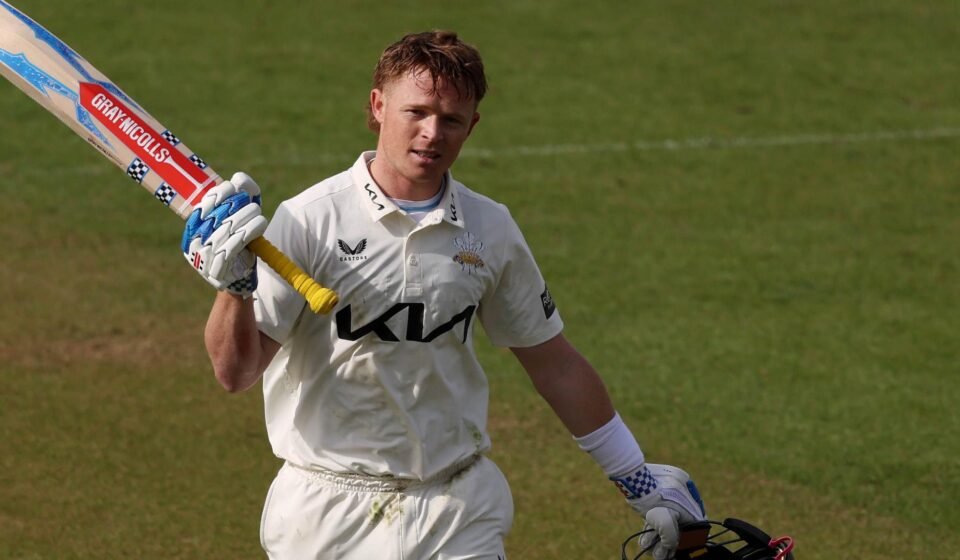

England batter Ollie Pope has withdrawn from the inaugural Afghanistan Premier League (APL) T20 draft, bringing fresh attention to the growing debate over cricket, human rights and the Taliban’s treatment of women and girls. His decision comes ahead of the player draft scheduled for October 24, with the tournament planned for later this year in the United Arab Emirates (UAE).
Pope was expected to be the only centrally contracted England player available for selection in the competition. His withdrawal has added pressure on English cricketers considering participation in the new franchise league, particularly after senior England officials expressed concerns about the situation facing women in Afghanistan.
According to BBC Sport, Pope made the decision independently of England cricket director Rob Key’s public position on the tournament. The development has once again raised a difficult question for international cricket: should professional players participate in competitions linked to a country whose authorities have imposed severe restrictions on women’s rights?
Why did Ollie Pope withdraw from the Afghanistan Premier League?
The controversy surrounding the Afghanistan Premier League extends beyond cricket. Since the Taliban returned to power in August 2021, women and girls in Afghanistan have faced extensive restrictions on education, employment, movement and participation in public life.
Women have also been banned from sporting activities under Taliban rule, leaving aspiring female athletes with limited opportunities to train and compete inside the country. These restrictions have drawn criticism from international human rights organisations and raised concerns about Afghanistan’s position within global sporting institutions. Reuters
Pope’s withdrawal has therefore become part of a wider discussion about the responsibilities of professional cricketers when commercial opportunities conflict with human rights concerns.
Although the England batter has not publicly issued a detailed statement explaining every aspect of his decision, the timing of his withdrawal has placed the issue firmly in the spotlight.
The Afghanistan Premier League is a franchise-based T20 competition organised by the Afghanistan Cricket Board. Its inaugural season is intended to bring international players into a tournament featuring Afghanistan’s cricketing talent.
However, the participation of overseas players has become controversial because of the political and human rights situation in Afghanistan.
Rob Key says players must make their own moral decisions
England cricket director Rob Key has acknowledged the concerns surrounding the tournament but admitted that preventing players from taking part could be legally difficult.
Speaking on the BBC’s Test Match Special podcast, Key said that participation ultimately involved a moral judgement for individual cricketers.
“Legally it is hard to stop players going over and playing in these competitions,” Key said, according to BBC Sport.
Key also made his personal position clear, saying he would not participate in the competition because he disagreed with the treatment of women in Afghanistan.
The England and Wales Cricket Board (ECB) has refused to arrange bilateral cricket series against Afghanistan since the Taliban returned to power. However, the board’s policy does not automatically prevent English players from joining overseas franchise tournaments.
Players require a No Objection Certificate (NOC) from the ECB to participate in such competitions. As a centrally contracted England player, Pope’s availability would have involved the board’s approval process.
His withdrawal has highlighted the difference between a cricket board expressing opposition to a government’s policies and introducing measures that prevent individual players from participating in commercial leagues.
The issue is particularly complicated because players may have different views about the relationship between professional sport, personal ethics and their careers.
Dawid Malan and other English players remain part of the debate
While Pope has withdrawn, other English cricketers have remained connected to the Afghanistan Premier League draft.
Former England batter Dawid Malan has defended the need for players to consider both their personal beliefs and their professional livelihoods. Moeen Ali and James Vince have also been among the English players associated with the draft, according to reports.
Malan’s position reflects a concern frequently raised by professional athletes: should the responsibility for making a political or ethical decision rest with individual players, or should governing bodies establish a consistent policy?
Players generally depend on their national boards for guidance on international commitments and eligibility for overseas competitions. When a board’s policy does not cover a particular franchise league, individuals may be left to make difficult decisions themselves.
That situation can create divisions within a dressing room and among supporters. Some believe refusing to participate sends a meaningful message about human rights, while others argue that players should not carry the entire burden of decisions that governments, sponsors and sporting organisations also influence.
The reported withdrawals of other players, including Will Smeed and David Willey, have further drawn attention to the debate ahead of the October 24 draft. Hindustan Times
Why England’s position on Afghanistan cricket is under scrutiny
England’s approach to Afghanistan has attracted criticism because the ECB has refused to schedule bilateral cricket against the country while continuing to compete against Afghanistan in major international tournaments.
England and Afghanistan have met at global events, including the 2025 ICC Champions Trophy. That distinction has prompted questions about whether the same principles should apply to bilateral series, international competitions and privately operated franchise leagues.
Before the Champions Trophy match in 2025, Labour MP Tonia Antoniazzi called for a boycott, arguing that the treatment of Afghan women and girls deserved a stronger response from the cricketing world.
Human Rights Watch has also urged the International Cricket Council (ICC) to address the exclusion of Afghan women and girls from cricket and support Afghan women cricketers living in exile. The organisation argued that the Taliban’s restrictions have prevented women from participating in sport and forced athletes to rebuild their lives outside the country.
The debate is not limited to England. Cricket Australia has also declined to proceed with certain bilateral engagements against Afghanistan over restrictions on women’s sport.
Critics argue that continuing normal sporting relationships without meaningful conditions risks weakening the message that gender equality should be a fundamental principle of international sport.
Others question whether boycotts are effective if they do not directly improve conditions for the people they are intended to support.
These competing arguments have made Afghanistan cricket one of the most difficult ethical questions facing international governing bodies.
Afghan women cricketers remain at the centre of the issue
One of the most significant aspects of the controversy is the position of Afghanistan’s own female athletes.
Before the Taliban takeover, the Afghanistan Cricket Board had begun building a women’s cricket programme and had contracted 25 female players in 2020. However, the team never played an official international match before the programme was disrupted by the change in government.
Many Afghan women cricketers subsequently left the country. Players living in exile have continued to pursue opportunities to train and play, including through initiatives in Australia.
Human Rights Watch has called on the ICC to provide a pathway for an Afghanistan women’s national team in exile to compete internationally. The organisation says that recognising these players would help ensure that Afghan women are not permanently excluded from the sport because of restrictions imposed by the authorities.
This is why the APL debate carries significance beyond the participation of a few overseas professionals. It raises questions about the responsibilities of cricket administrators towards women who have been denied the opportunity to represent their country.
The ICC’s treatment of Afghanistan’s men’s team, alongside the continuing absence of an officially recognised women’s national team, remains a central point of discussion.
What happens next for the Afghanistan Premier League?
Pope’s withdrawal does not, by itself, determine the future of the Afghanistan Premier League. The tournament’s wider prospects will depend on its organisation, regulatory approval and the willingness of players to participate.
However, the decision has ensured that the ethical debate will remain part of the build-up to the inaugural season.
For the ECB, the challenge is to clarify its position on overseas franchise competitions while considering the legal limits of its authority. For players, the question is whether participation should be viewed purely as a professional opportunity or also as an endorsement of the wider sporting environment.
For the ICC, the controversy adds to existing questions about how membership standards, women’s participation and human rights commitments should be applied consistently across international cricket.
Ollie Pope’s decision may ultimately be a personal one, but the discussion it has triggered is much larger. Cricket’s global popularity gives its governing bodies and leading players a platform that extends beyond the boundary rope.
Whether other English cricketers follow Pope’s example remains to be seen. What is clear is that the relationship between sport and human rights will continue to influence decisions surrounding the Afghanistan Premier League.
Stay tuned to ROKOCRICKET for the latest cricket news, tournament updates, player decisions and developments from the international cricket world. Subscribe and follow us for more breaking cricket stories and in-depth coverage.