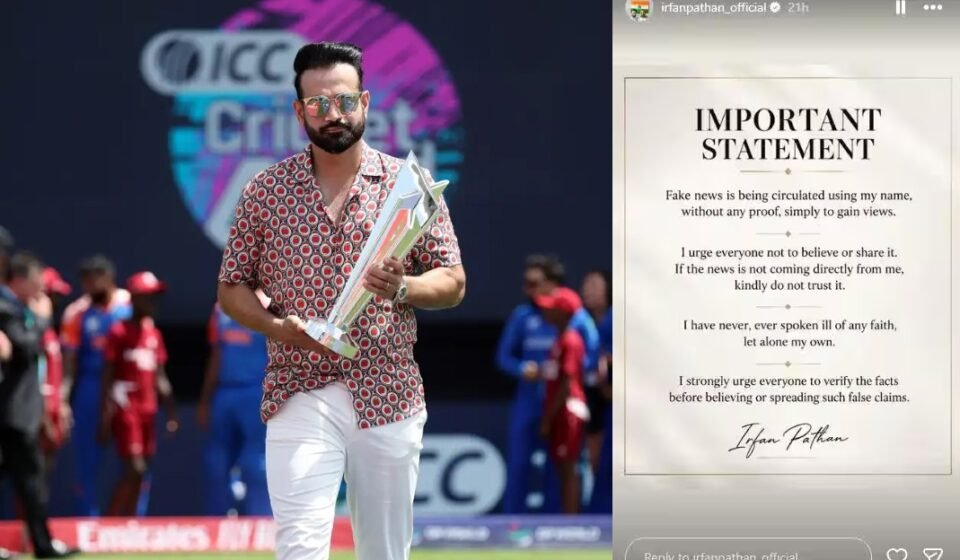

Former India all-rounder Irfan Pathan has issued a strong clarification after false statements attributed to him began circulating on social media. The former Indian cricketer said he had never spoken negatively about any religion and urged people not to believe or share unverified claims associated with his name.
The 41-year-old took to Instagram to address the issue, expressing concern over people allegedly spreading misleading information without evidence to attract views and engagement. His message was straightforward: statements should not be attributed to him unless they can be verified through his own communication.
The Irfan Pathan fake news story has attracted attention because it involves claims about religion, a subject that can quickly trigger heated reactions online. By addressing the matter directly, Pathan has asked his followers to check the facts before drawing conclusions about his views.
Why did Irfan Pathan have to issue a clarification?
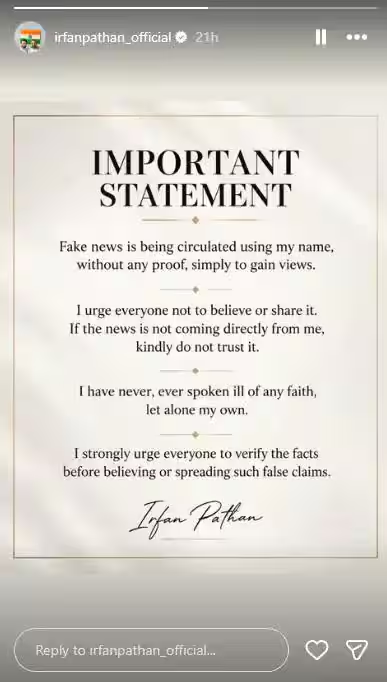
According to Pathan’s statement, some social media users were circulating misleading claims using his name without providing evidence to support them.
The former India cricketer said such content was being shared to generate views. He urged people to avoid believing or forwarding posts that did not originate from him directly.
In his message, Pathan made it clear that he had never spoken ill of any faith, including his own. He also encouraged people to verify the authenticity of statements before accepting them as genuine.
His clarification comes amid the continuing problem of misleading sports-related content on social media. Statements attributed to well-known athletes can spread rapidly, particularly when they involve sensitive subjects or provoke strong reactions.
However, the existence of a viral post does not establish that the person named in it actually made the statement. Without an authentic source, screenshots, short clips and unattributed quotations can give readers an incomplete or misleading picture.
Pathan’s response is therefore also a reminder to fans to distinguish between a verified statement and a claim circulated by an unrelated account.
What did Irfan Pathan say about religion?
Pathan’s central message was that he had never made negative remarks about any religion.
He objected to the circulation of unsubstantiated claims and asked his followers not to trust or share statements attributed to him unless they came directly from him.
The former cricketer’s appeal was not limited to asking people to disregard the particular claims circulating online. He also emphasised the importance of checking facts before spreading information about anyone.
For public figures, misinformation can create confusion about their opinions and potentially damage their reputations. A statement shared thousands of times may appear credible to some readers even when its original source is unclear.
That is why checking an athlete’s verified social media account, an original interview or a reliable news report can make a difference.
At the same time, readers should avoid assuming that every viral post is false or genuine without examining the available evidence. The appropriate approach is to establish the source and context before reaching a conclusion.
In this case, Pathan has publicly rejected the claims attributed to him and asked people to exercise caution.
Irfan Pathan remains active in cricket through WCL
Away from the social media issue, Pathan continues to remain connected with cricket through the World Championship of Legends (WCL).
The former India international is representing India Champions in the tournament. The competition brings former international cricketers back onto the field, giving supporters an opportunity to watch familiar names compete again.
Pathan’s involvement reflects the continued appeal of retired international players, many of whom remain popular with fans long after their international careers have ended.
His experience as an international all-rounder also makes him a familiar figure among Indian cricket followers. During his playing days, he contributed with both bat and ball and was part of India’s successful campaign at the inaugural ICC Men’s T20 World Cup in 2007.
The current WCL campaign has brought former international players back into the spotlight, with their performances and off-field statements attracting attention from cricket audiences.
For Pathan, however, the immediate issue has been the circulation of statements he says do not reflect what he has said.
A look at Irfan Pathan’s international cricket career
Pathan represented India across all three major international formats. He played 29 Test matches, 120 One Day Internationals and 24 T20 Internationals during his international career.
He first came to prominence as a left-arm fast bowler capable of swinging the ball, particularly in favourable conditions. His early performances generated considerable excitement among Indian supporters, and he later developed into a useful all-round option.
One of the most memorable moments of his career came during the second Test against Pakistan in Karachi in January 2006. Pathan took a hat-trick in the opening over of Pakistan’s first innings, dismissing Salman Butt, Younis Khan and Mohammad Yousuf.
The achievement remains one of the most recognisable moments in Indian Test cricket history. Pathan also played a part in India’s 2007 T20 World Cup triumph in South Africa, where the team defeated Pakistan in the final.
Following his playing career, he remained involved in the sport through commentary, analysis and other cricket-related activities. His public profile means that comments attributed to him can attract substantial attention, making accurate reporting particularly important.
Why verifying viral cricket news matters
The episode involving Pathan highlights a challenge faced by sports personalities and audiences alike. Social media allows news to travel quickly, but the speed of distribution does not guarantee accuracy.
A misleading quotation can be copied from one account to another until readers begin treating it as an established fact. When the subject concerns religion, politics or other sensitive issues, the consequences can extend beyond ordinary sports discussion.
Fans can take a few simple steps to avoid contributing to the spread of misinformation:
- Check the original source: Look for the full statement on the person’s verified social media account or in an authentic interview.
- Read beyond the headline: A headline or caption may leave out important context.
- Look for independent confirmation: Check whether established news organisations have reported the same claim.
- Avoid sharing unverified screenshots: An image containing a quotation is not, by itself, proof that the person said it.
- Correct mistakes responsibly: If a claim turns out to be inaccurate, avoid repeating it as fact and share the verified information instead.
These steps are especially useful when a post is designed to provoke an immediate emotional reaction.
What happens next?
For now, Pathan’s position is clear. He has denied speaking negatively about any religion and has urged people to stop circulating unverified statements attributed to him.
The clarification addresses the claims he has publicly rejected, but it is important not to speculate about the identity or motives of individual accounts without supporting evidence.
As he continues his involvement with India Champions in the World Championship of Legends, cricket supporters will be watching both the tournament and developments surrounding the story.
The broader lesson is equally important: a viral claim should not automatically be treated as a verified statement, regardless of how famous the person involved may be.
Stay tuned to ROKOCRICKET for the latest cricket news, player updates, tournament developments and verified sports stories. Subscribe to our updates so you do not miss the biggest developments from the world of cricket.