Harry Brook breaks Shubman Gill’s record with fastest ODI double century
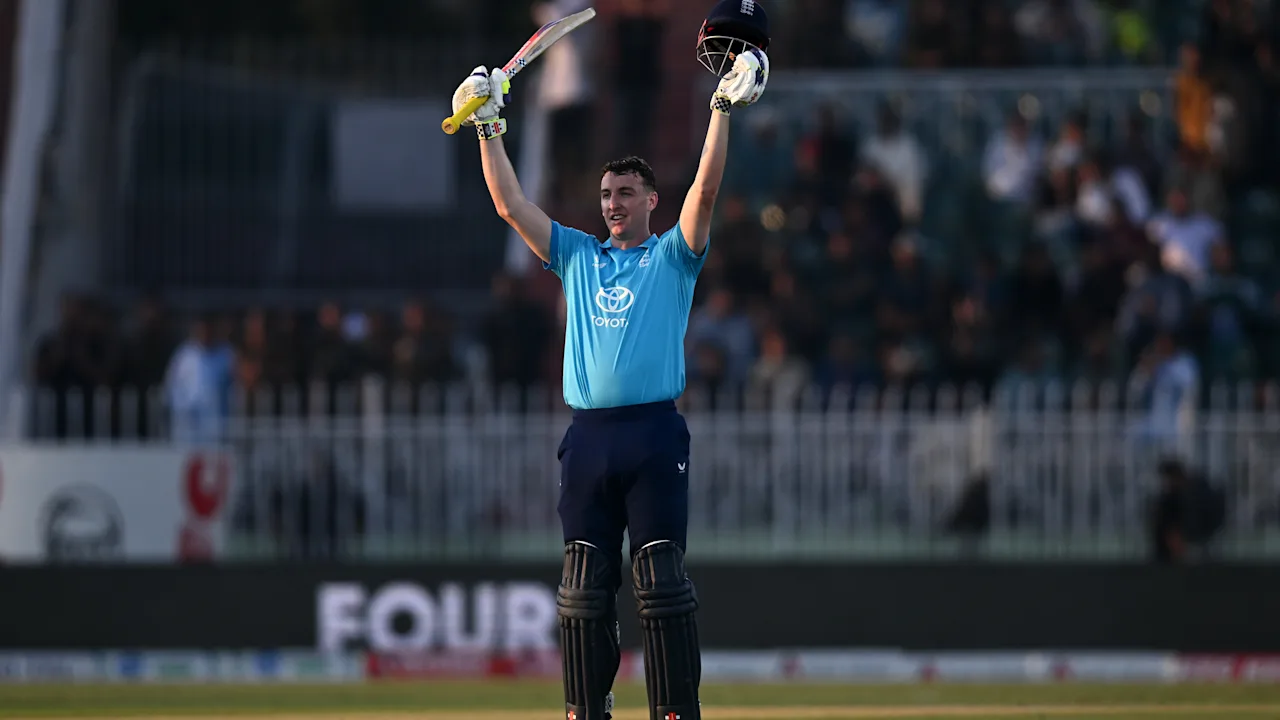
Harry Brook celebrates his record-breaking 202 off 116 balls against Sri Lanka in the ODI tri-series at Rawalpindi Cricket Stadium on October 22, 2026.
England captain Harry Brook produced a sensational innings against Sri Lanka on Thursday, October 22, 2026, to rewrite the record books in men’s one-day international cricket. The right-handed batter smashed a remarkable 202 off just 116 balls in the ODI tri-series match at Rawalpindi Cricket Stadium, reaching his double century in only 114 deliveries to break Shubman Gill’s record for the fastest ODI double century.
Brook’s extraordinary knock powered England to 429/4 in 50 overs, putting the team in a commanding position after its opening defeat to Pakistan. His innings featured 21 fours and 10 sixes, showcasing an impressive combination of calculated batting, innovative stroke play and relentless aggression.
The England skipper achieved two major milestones in the same innings. He became the first English batter to score a double century in men’s ODIs and surpassed India’s Gill, who had reached 200 in 117 balls against West Indies in Guwahati last month.
The record has changed hands again in a format where modern batters continue to challenge the limits of aggressive run-scoring.
Harry Brook’s 114-ball double century creates ODI history
The Harry Brook fastest ODI double century record is particularly remarkable because of the speed at which he accelerated after settling into his innings. Rather than attacking every delivery from the beginning, Brook built his innings before shifting gears and putting the Sri Lankan bowlers under enormous pressure.
He reached his first century in approximately 75 balls, using a ramp shot over fine leg to bring up the milestone. His ability to find gaps behind the wicket and attack deliveries outside off stump made it difficult for Sri Lanka to establish control.
Brook continued his assault to reach 150 before launching an even more destructive attack in the closing overs. He needed only around 39 additional balls to move from 150 to 200, demonstrating just how dramatically he increased his scoring rate.
The double century arrived through a paddle sweep against Janith Liyanage in the final over. Brook was dismissed on the last delivery of the innings, finishing with 202 from 116 balls.
His 31 boundaries accounted for 146 runs, including 21 fours and 10 sixes. The innings was not simply about power hitting; Brook repeatedly used unconventional shots to disrupt the bowlers’ plans and force changes in field placement.
Harry Brook vs Shubman Gill: fastest double centuries in ODI cricket
Shubman Gill had only recently taken the record after producing a magnificent double century against West Indies in Guwahati. His 223 not out from 133 deliveries included a double-century milestone reached in 117 balls.
Brook has now moved ahead of Gill by three balls, establishing a new benchmark in men’s ODI cricket.
The leading performances on the fastest ODI double-century list are:
- 114 balls — Harry Brook vs Sri Lanka, 2026
- 117 balls — Shubman Gill vs West Indies, 2026
- 126 balls — Ishan Kishan vs Bangladesh, 2022
- 128 balls — Glenn Maxwell vs Afghanistan, 2023
- 136 balls — Pathum Nissanka vs Afghanistan, 2024
- 138 balls — Chris Gayle vs Zimbabwe, 2015
- 140 balls — Virender Sehwag vs West Indies
These innings underline how quickly the demands of ODI batting have evolved. While reaching 200 runs once appeared to require a long period at the crease, the leading players are increasingly combining consistency with extraordinary acceleration.
Brook’s achievement is even more significant because Gill’s previous record had already represented a major leap forward. Beating it so soon reinforces the competitive nature of modern international cricket.
England’s first ODI double centurion surpasses Ben Stokes
Before Brook’s innings, England had never produced a men’s ODI double centurion. The country’s previous highest individual score in the format belonged to Ben Stokes, who scored 182 against New Zealand.
Brook has now moved beyond that mark with his 202-run effort, setting a new national record while also establishing the fastest double century in ODI history.
The milestone reflects the England captain’s ability to adapt his batting to different phases of an innings. He began by assessing the conditions and the bowling attack, then increased the tempo as the innings progressed.
His innings also highlighted the value of an established batter remaining at the crease during the final overs. Once Brook had settled, Sri Lanka struggled to contain the scoring rate, particularly when he combined placement with powerful shots over the boundary.
The result was an innings that transformed a strong total into a potentially match-defining one.
Joe Root, Tom Banton and Will Jacks support Brook
Although Brook dominated the headlines, England’s other batters made important contributions to the imposing total.
Joe Root scored 69, providing stability and helping England build a platform for the late acceleration. His contribution ensured that Brook could continue attacking without the pressure of having to rebuild the innings after every wicket.
Tom Banton also scored a half-century, adding momentum to England’s batting effort. Will Jacks finished unbeaten on 66, providing a powerful finish alongside Brook.
The partnership between Brook and Jacks proved especially damaging in the closing stages. England collected 156 runs in the final 10 overs, an extraordinary scoring burst that took the total to 429/4.
That late surge demonstrated the importance of maintaining wickets in hand. With established batters still at the crease, England could attack almost every scoring opportunity without sacrificing its overall momentum.
For Sri Lanka, the final overs turned an already challenging bowling assignment into a difficult afternoon.
Sri Lanka’s bowlers struggle to contain England
Sri Lanka’s pace attack endured a difficult outing at Rawalpindi Cricket Stadium. Eshan Malinga conceded 91 runs without taking a wicket, while Dilshan Madushanka gave away 89 runs without a breakthrough.
Dasun Shanaka, returning to ODI cricket after more than two years, also came under pressure and conceded 74 runs from his six overs.
Left-arm spinner Dunith Wellalage was among the more effective bowlers, returning figures of 2/56. However, Sri Lanka struggled to maintain control as Brook and England’s middle order repeatedly found boundaries.
The challenge was not limited to individual bowling figures. England’s batters consistently forced Sri Lanka to adjust its fields, making it difficult to defend both the boundaries and the gaps.
Brook’s innovative stroke play further complicated matters. His use of ramps, paddle sweeps and shots behind the wicket reduced the effectiveness of conventional defensive fields.
With 429 runs on the board, England gave its bowling attack a substantial total to defend.
Stay tuned to ROKOCRICKET for the latest cricket news, breaking records, match updates, player performances and expert analysis. Subscribe to ROKOCRICKET and follow every major moment from international cricket as the action unfolds.