Afghanistan vs Zimbabwe: Why Brian Bennett survived after being bowled by Azmatullah Omarzai
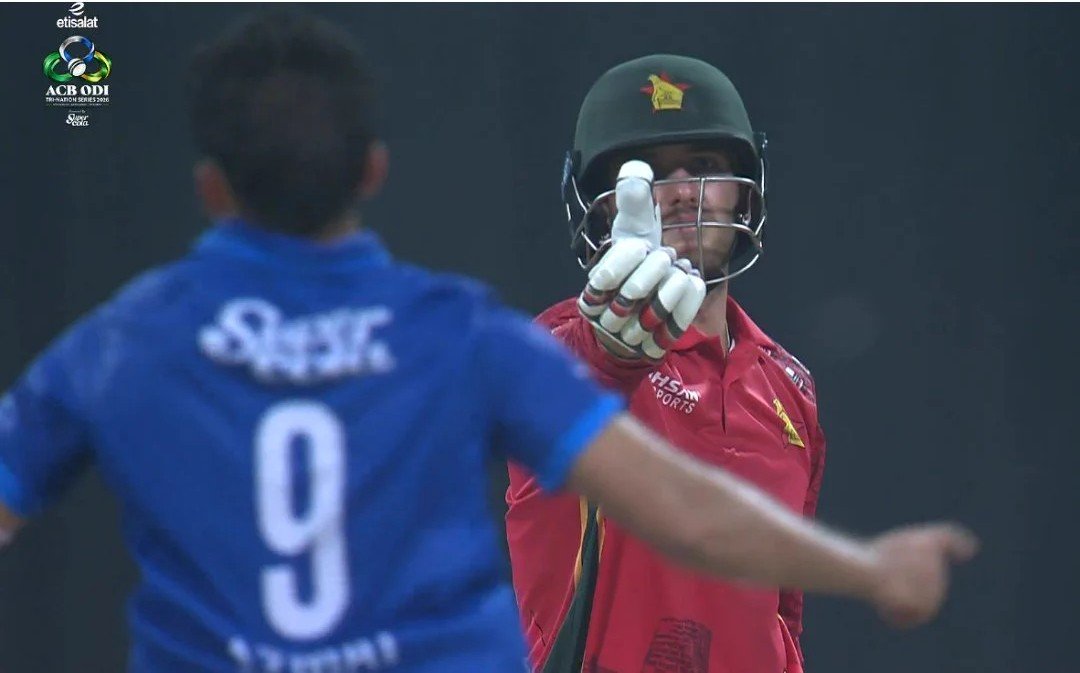
Brian Bennett survives after Azmatullah Omarzai bowls him during the Afghanistan vs Zimbabwe ODI tri-series match.
A bizarre incident during the Afghanistan vs Zimbabwe ODI tri-series left cricket fans stunned when Brian Bennett was bowled by Azmatullah Omarzai but escaped dismissal after the umpires called the delivery dead. The ball was not a no-ball, and the stumps had been hit, yet Afghanistan were denied a wicket because Omarzai’s towel fell during his delivery stride.
The unusual decision quickly became a talking point, raising questions about the laws of cricket, the role of umpires in judging distractions and whether a batter can be given a reprieve after being clean bowled.
The incident occurred during Zimbabwe’s innings, when Afghanistan were looking to maintain control of the contest. Omarzai, one of Afghanistan’s key pace-bowling options, was running in to deliver the final ball of the eighth over when the towel tucked into his waistband fell to the ground.
Omarzai released the ball as the incident unfolded. Bennett attempted to play a pull shot but failed to make contact, allowing the delivery to crash into the stumps. The bails came off, and Afghanistan’s players initially celebrated what appeared to be a straightforward dismissal.
However, the celebration did not last long. Bennett immediately raised a concern with the umpires, indicating that the falling towel had distracted him. After a discussion, the officials ruled the delivery dead, allowing the Zimbabwe batter to continue his innings.
The decision surprised many viewers because the ball had clearly hit the stumps and there was no apparent no-ball infringement. But the situation was not simply about whether the delivery was legal. It also involved the umpires’ authority to intervene when an unusual event may have distracted a batter.
Why was Brian Bennett not out?
The central issue was the falling towel and whether it unfairly distracted Bennett while he was preparing to face the delivery.
Under cricket’s laws, an umpire can call and signal dead ball in certain circumstances involving unfair distraction or interference. The relevant provisions give officials the authority to judge whether an unexpected event has affected the batter’s ability to face the delivery fairly.
That does not mean every falling object automatically makes a delivery dead. The circumstances matter, including when the distraction occurred, whether it was relevant to the batter’s ability to play the ball and whether the umpires considered intervention justified.
In this case, the officials accepted the concern and ruled the delivery dead. As a result, the apparent dismissal did not stand.
The distinction between a dead ball and a no-ball is important. A no-ball is an illegal delivery under the relevant laws and playing conditions, with consequences for the batting side’s score and the bowler’s figures. A dead ball, by contrast, means the delivery is not treated as a live ball for the purposes of continuing play. Depending on the circumstances, the ball may not count as a valid delivery in the over.
This is why a batter can, in certain situations, survive even when the ball has physically struck the stumps. The outcome depends on the applicable law and the umpire’s decision, not simply on whether the bails have been dislodged.
Was the umpire’s decision correct?
The decision prompted debate because Bennett still attempted to play the ball despite the towel falling. Some observers could argue that his attempt to play the delivery suggested the incident did not prevent him from competing for the ball.
Others may point out that a batter can attempt a shot and still be distracted by an unexpected movement or object. The fact that Bennett played at the delivery does not, by itself, settle whether the distraction was significant enough to justify a dead-ball call.
The key question is whether the umpires reasonably judged that the falling towel created a distraction that warranted stopping play under the applicable laws.
It is also important to distinguish an umpire’s discretionary judgment from an automatic rule. Cricket does not provide a blanket exemption whenever a bowler drops a towel, cap or other item. Nor does the sight of the ball hitting the stumps automatically override a valid dead-ball decision.
Without the complete match footage and the officials’ precise explanation, it would be premature to declare the ruling unquestionably correct or incorrect. The incident nevertheless illustrates how unusual circumstances can turn an apparently routine dismissal into a complicated decision.
For bowlers, it is a reminder that equipment and clothing should be secured before beginning the delivery stride. For batters, it highlights the importance of communicating a genuine distraction to the officials. Ultimately, the umpires must apply the laws consistently and assess the specific circumstances in front of them.
Afghanistan dominated despite the unusual reprieve
Although Bennett received an unexpected lifeline, Zimbabwe could not turn the moment into a major recovery. He eventually departed for 31, while Zimbabwe’s innings collapsed to 136.
Afghanistan had already laid the foundation for victory with an imposing total of 294. Sediqullah Atal led the scoring with an excellent 102, while Ibrahim Zadran contributed a valuable 90. Their partnership and individual performances put Zimbabwe under considerable pressure and gave Afghanistan’s bowlers a substantial total to defend.
Rashid Khan then played a decisive role with the ball, taking four wickets for just 17 runs. His spell helped dismantle Zimbabwe’s batting order and ensured Afghanistan remained firmly in control.
Afghanistan ultimately secured a commanding 158-run victory. The result underlined the difference between the teams on the day, with Afghanistan delivering a strong performance with both bat and ball.
The win also demonstrated why Afghanistan have become a competitive force in international limited-overs cricket. Their batting depth, quality spin bowling and increasingly effective pace attack make them a challenging opponent, particularly when they build a sizeable total.
A rare moment that put cricket’s laws in the spotlight
Cricket is often decided by fine margins, but this incident showed that the laws governing a match can be just as influential as the action between bat and ball.
For Afghanistan, the overturned dismissal was a brief interruption in an otherwise dominant performance. For Bennett, it was an unusual escape that ultimately did little to change Zimbabwe’s fortunes. For fans, it provided a reminder that a ball hitting the stumps does not always tell the complete story.
The episode also highlights why umpires must balance the natural flow of a match with the responsibility to ensure that neither side gains an unfair advantage from an unexpected distraction. Such decisions are rarely straightforward when the action unfolds in a split second.
The most important takeaway is that a falling towel does not automatically save a batter. The decision depends on the circumstances and the relevant laws, as interpreted by the umpires.
Afghanistan’s emphatic victory remained the main sporting story, but the unusual dead-ball call ensured that Omarzai’s delivery became one of the most discussed moments of the match.
Stay tuned to ROKOCRICKET for the latest cricket news, match reports, player updates and the stories behind the game. Subscribe to stay updated on the biggest moments from international cricket.