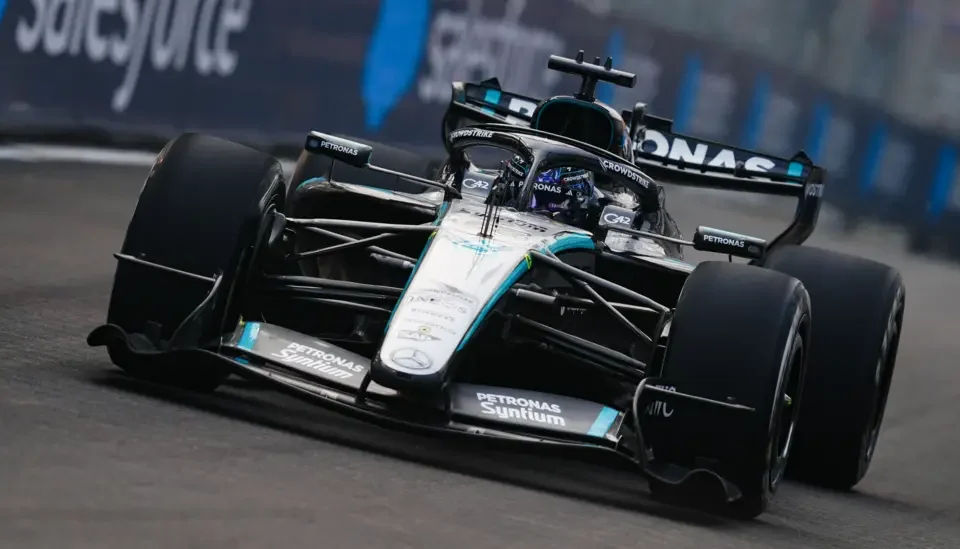

George Russell set the pace in Singapore Grand Prix practice, putting Mercedes at the top of the timesheets ahead of Ferrari’s Charles Leclerc and McLaren’s Lando Norris. However, the British driver’s impressive performance came with an important caveat: he is expected to start Sunday’s Grand Prix from the back of the grid because of an engine-related penalty.
Leclerc produced a late lap to secure second place, finishing just 0.198 seconds behind Russell. Norris was third fastest, 0.273 seconds off the Mercedes driver’s benchmark, while Lewis Hamilton finished fourth for Ferrari.
Oscar Piastri completed the top five as the leading drivers prepared for a sprint weekend at the demanding Marina Bay Street Circuit. With only one practice session scheduled before sprint qualifying, teams had limited time to understand their cars and establish a clear performance picture.
According to the official Formula 1 schedule, sprint qualifying is scheduled for Friday evening in Singapore, making every minute of practice particularly important.
Singapore Grand Prix practice: Russell leads the field
Russell delivered the fastest lap of the session to put Mercedes ahead of its major rivals. Leclerc’s late improvement prevented the session from ending with a British one-two-three, as Norris and Hamilton also demonstrated competitive pace.
The top five were separated by less than half a second, highlighting the potential for a close fight as the Singapore Grand Prix weekend progresses.
| Position | Driver | Team | Gap to Russell |
|---|---|---|---|
| 1 | George Russell | Mercedes | Leader |
| 2 | Charles Leclerc | Ferrari | +0.198s |
| 3 | Lando Norris | McLaren | +0.273s |
| 4 | Lewis Hamilton | Ferrari | +0.499s |
| 5 | Oscar Piastri | McLaren | Not specified |
The timesheets offered encouraging signs for Ferrari and McLaren, with both teams placing two drivers inside the top five. Mercedes, meanwhile, had Russell at the front but still faced questions about whether its recent technical changes would deliver the improvement expected.
The most important detail was the tyre selection. The leading five drivers recorded their best times on soft tyres, while several rivals used the medium compound. That difference makes a direct comparison difficult and means the practice results should not automatically be treated as a prediction for sprint qualifying.
Why Mercedes is testing different car specifications
Mercedes arrived in Singapore with a significant technical question to answer after a difficult weekend in Malaysia.
The team had expected its latest aerodynamic developments to improve performance, but the results at Sepang fell short of expectations. Engineers therefore decided to run different specifications on the two cars to gather more information.
Russell reverted to an earlier specification, while team-mate Kimi Antonelli continued with the newer aerodynamic package.
This comparison could prove valuable. By examining how the two configurations behave at the same circuit, Mercedes can better understand whether the latest developments are delivering the intended benefits or whether further adjustments are needed.
There is, however, a limitation. The sprint format provides just one practice session before qualifying, leaving engineers with less time than they would have during a conventional Grand Prix weekend.
Russell’s fastest time is encouraging, but it does not establish that the older specification is necessarily superior. Differences in tyre compounds, fuel loads, setup choices and run plans can all influence lap times.
Mercedes will need to examine the underlying data before making firm conclusions about its development direction.
Russell’s engine penalty creates another challenge
Russell’s pace is particularly noteworthy because his weekend already comes with a major disadvantage.
The Mercedes driver suffered a power-unit failure while running third late in the Bahrain Grand Prix in Malaysia. The resulting damage forced the team to change its engine plans and use additional power-unit components beyond the permitted allocation.
That leaves Russell facing a start from the back of the grid for Sunday’s Singapore Grand Prix.
The penalty changes the significance of his practice performance. Although Russell can still fight for a strong position in sprint qualifying and compete for points in Saturday’s sprint, his main Grand Prix challenge will be recovering positions on a circuit where overtaking can be difficult.
The Marina Bay layout features tight corners, barriers close to the track and limited room for drivers to make mistakes. A strong qualifying position is normally valuable, making Russell’s expected grid drop an especially difficult obstacle.
His immediate priority will be to extract as much performance as possible from the car while helping Mercedes understand the differences between its two specifications.
The sprint also offers an opportunity to collect useful data under competitive conditions before Sunday’s longer race.
Verstappen shows promise on medium tyres
Max Verstappen finished sixth, making him the fastest driver outside the top five and the leading runner on medium tyres.
The Red Bull driver was 0.732 seconds behind Russell, but he was also 0.519 seconds quicker than Antonelli, who finished seventh on the same compound.
Verstappen’s position deserves attention because the medium tyre generally provides a different performance picture from the soft compound. Without matching tyre strategies, the gaps between the cars do not provide a reliable measure of their true competitive order.
Red Bull will nevertheless take encouragement from the session after Verstappen secured his first victory of the season at Sepang. The team appeared competitive at points in Singapore before different tyre programmes made comparisons more difficult.
Isack Hadjar finished eighth for Red Bull’s sister team, Racing Bulls’ Liam Lawson was 10th, and Pierre Gasly placed ninth for Alpine.
Fernando Alonso briefly appeared inside the top 10 before dropping to 14th as the session progressed.
The next competitive sessions should provide a clearer indication of whether Red Bull can challenge Mercedes, Ferrari and McLaren around the tight street circuit.
Singapore haze raises concerns away from the track
While teams focused on lap times and car performance, Singapore was also dealing with an environmental concern linked to haze from wildfires in neighbouring Indonesia.
The smoke, associated largely with land-clearing practices including slash-and-burn methods, has contributed to poor air quality across the city-state. Residents have been advised to limit outdoor activities amid concerns about elevated pollution levels.
The issue adds another consideration to an already demanding race weekend. The Marina Bay Street Circuit is known for its heat and humidity, and drivers must manage physical exertion while maintaining concentration through a series of tight corners.
Any deterioration in air quality could make conditions more uncomfortable for spectators, trackside personnel and residents. The situation also places additional attention on local air-quality monitoring as the Formula 1 event continues.
The sporting programme remains focused on the racing, but the haze is an important part of the wider picture surrounding this year’s Singapore Grand Prix.
What happens next at the Singapore Grand Prix?
Friday’s sprint qualifying session will provide the first meaningful competitive test after practice. Drivers will have to find speed quickly, with limited opportunities to fine-tune their cars before the sprint.
Saturday brings the sprint and the main qualifying session, followed by Sunday’s Grand Prix on 11 October.
Singapore Grand Prix 2026 schedule
9 Oct
Friday
Sprint qualifying
20:30–21:14 Singapore time
13:30–14:14 BST
10 Oct
Saturday
Sprint race
17:00 Singapore time
Grand Prix qualifying
21:00 Singapore time
11 Oct
Sunday
Singapore Grand Prix
20:00 Singapore time · 13:00 BST
Source: Official Formula 1 weekend timetable.
Russell leads, but the real battle is still ahead
Russell’s fastest lap gives Mercedes a positive starting point, but the practice results leave several questions unanswered. Ferrari has shown enough pace to remain in contention, McLaren has placed both drivers near the front, and Verstappen could become a serious threat if Red Bull translates its practice performance into qualifying speed.
For Mercedes, the bigger test is whether its contrasting car specifications will help identify a clear route to improved performance. Russell’s engine penalty also means that a fast lap alone will not solve the team’s Sunday challenge.
Sprint qualifying should provide a more meaningful comparison between the leading teams, although the unique demands of the Marina Bay circuit can still produce surprises.
Stay tuned to ROKOCRICKET for the latest Formula 1 news, Singapore Grand Prix updates, sprint results and race analysis. Subscribe and join the conversation as the battle unfolds under the Singapore lights.
What do you think? Can George Russell turn his practice pace into a strong sprint result despite his engine penalty, or will Ferrari and McLaren take control? Share your opinion in the comments.