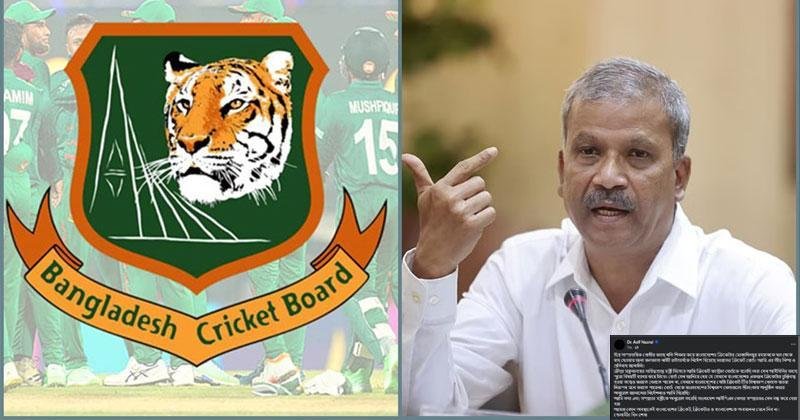
Bangladesh T20 World Cup 2026 Withdrawal: Investigation Names Asif Nazrul as Key Decision-Maker

Bangladesh T20 World Cup 2026 Withdrawal: Bangladesh’s decision to miss the ICC Men’s T20 World Cup 2026 has returned to the spotlight after a government investigation reportedly held former sports adviser Asif Nazrul responsible for the call. The three-member inquiry committee released its findings on September 15, 2026, several months after Bangladesh’s withdrawal led to Scotland taking its place in the tournament.
According to reports from Bangladeshi media, the investigation concluded that Nazrul made the decision to prevent Bangladesh from travelling to India. The findings have raised fresh questions about the role of the government, the Bangladesh Cricket Board (BCB), and the communication surrounding one of the most unexpected developments in international cricket this year.
Bangladesh T20 World Cup 2026 withdrawal: What happened?
Bangladesh’s absence from the 2026 T20 World Cup was linked to growing tensions between India and Bangladesh and the decision to hold the tournament across India and Sri Lanka. Bangladesh had been scheduled to play its matches in India, but the country’s cricket authorities requested that its fixtures be moved to Sri Lanka, citing security concerns.
The dispute came at a particularly sensitive time in bilateral relations. The situation also followed a controversy involving Bangladesh fast bowler Mustafizur Rahman and his IPL 2026 participation. However, it is important to distinguish the background to the dispute from the formal reasons given by the Bangladesh Cricket Board and the International Cricket Council.
The ICC said on January 21 that it had reviewed security assessments, including independent evaluations, and found no threat to Bangladesh players, officials, media personnel, or supporters at the tournament venues in India. The governing body also said that moving Bangladesh’s matches so close to the competition would not be feasible.
The BCB maintained its position and refused to send the team to India under the published schedule. On January 24, the ICC announced that Scotland would replace Bangladesh in the tournament.
The decision meant that Bangladesh missed a major global competition, while Scotland received a late opportunity to compete on the international stage. Scotland was selected as the replacement under the ICC’s qualification and governance process.
Investigation report names Asif Nazrul
The latest development came from a three-member investigation committee established in Bangladesh to examine why the national team did not participate in the T20 World Cup.
According to bdnews24.com and The Daily Star, the committee’s report identified Asif Nazrul, who was serving as the interim government’s youth and sports adviser at the time, as the central figure behind the withdrawal decision. The committee reportedly concluded that the interim government was also responsible for the decision.
The inquiry was headed by a senior official from the Ministry of Youth and Sports and included lawyer Faisal Dastagir and former Bangladesh captain Habibul Bashar, according to reporting by bdnews24.com. The committee examined statements from people involved in the episode and reviewed relevant reports and other material.
The report reportedly stated that the decision to stop Bangladesh from travelling to India was made without an independent security assessment. It also suggested that the country’s highest level of government and the BCB board of directors had not formally decided to withdraw the team on security grounds.
These findings are significant because the withdrawal had previously been presented publicly as a matter of safety and security. The inquiry’s account instead focuses on the decision-making process and the role of the sports ministry.
Players reportedly wanted to play in the World Cup
One of the most notable details in the investigation is the reported position of Bangladesh’s players.
According to coverage of the inquiry, T20I captain Litton Das and Test captain Najmul Hossain Shanto told the committee that they had expressed a desire to participate in the World Cup. Their reported statements suggest that the players were willing to take part, but the final decision was made at the government level.
The committee also reportedly interviewed members of the coaching staff and senior BCB officials as part of its investigation. These accounts were used to examine how the withdrawal decision was communicated and whether the cricket board had a meaningful role in reaching it.
The findings have therefore shifted attention away from the players and towards the administration responsible for deciding whether the team would travel.
It remains important to remember that an investigation report represents the conclusions of the committee that prepared it. The findings should be read alongside any response from Asif Nazrul, the former interim government, and other parties named in the report.
How the Mustafizur Rahman and IPL dispute became part of the story
The Bangladesh withdrawal also became connected to the controversy involving Mustafizur Rahman and the IPL 2026 season.
Mustafizur, one of Bangladesh’s leading fast bowlers, was involved with Kolkata Knight Riders during the period when tensions surrounding Bangladesh and India were affecting cricket-related decisions. His removal from the IPL became a major talking point in Bangladesh and added to the wider disagreement.
The Bangladesh authorities subsequently sought to move their T20 World Cup matches from India to Sri Lanka. The BCB cited security concerns, while the ICC said its assessments had not identified a credible or verifiable security threat to the Bangladesh team in India.
The ICC and the BCB held discussions for more than three weeks. The governing body ultimately decided to retain the published schedule and gave Bangladesh a deadline to confirm its participation. After the BCB did not provide the required confirmation, the ICC replaced Bangladesh with Scotland on January 24.
Although the IPL dispute formed part of the wider background, the ICC’s official explanation for Bangladesh’s removal centred on the refusal to participate according to the published schedule and the failure to resolve the venue disagreement.
Why the inquiry matters for Bangladesh cricket
The investigation has opened a broader discussion about governance and decision-making in Bangladesh cricket.
A national team’s participation in a major ICC tournament involves more than the players and coaching staff. It requires coordination between the cricket board, government authorities, security agencies, tournament organisers, and international governing bodies. When those groups disagree, the consequences can affect the players, fans, sponsors, broadcasters, and the country’s international sporting reputation.
The inquiry reportedly highlighted problems involving strategic leadership, crisis management, communication, and long-term planning. It also questioned whether the BCB had sufficient independence when dealing with a major international issue.
For Bangladesh cricket, the episode is a reminder of how quickly an administrative dispute can turn into a major sporting setback. The national team lost the opportunity to compete in a global tournament, and Scotland was brought in as a replacement only weeks before the competition began.
The report may now become part of discussions about how future cricket decisions should be handled, especially when sporting events intersect with diplomatic or political tensions.
What happens next?
The release of the investigation report does not automatically settle every question surrounding Bangladesh’s withdrawal. The next stage will depend on how the people and institutions named in the findings respond.
Asif Nazrul and other officials may face questions about the process used to reach the decision, while the BCB’s role in the negotiations could also receive further scrutiny. The report’s conclusions, along with any official responses, will help establish how the episode is understood in Bangladesh.
For supporters, the central issue remains straightforward: Bangladesh had qualified for the T20 World Cup, but the team did not take part after the dispute over playing in India. The ICC then selected Scotland as its replacement.
The investigation has now added a new dimension to that story by identifying a specific decision-maker and raising questions about the balance between government authority and cricket administration.
Stay tuned to ROKOCRICKET for more updates on Bangladesh cricket, international cricket news, major tournament developments, and the latest stories from the world of sports. What do you think about the investigation’s findings? Share your opinion in the comments and subscribe to ROKOCRICKET for more cricket news.