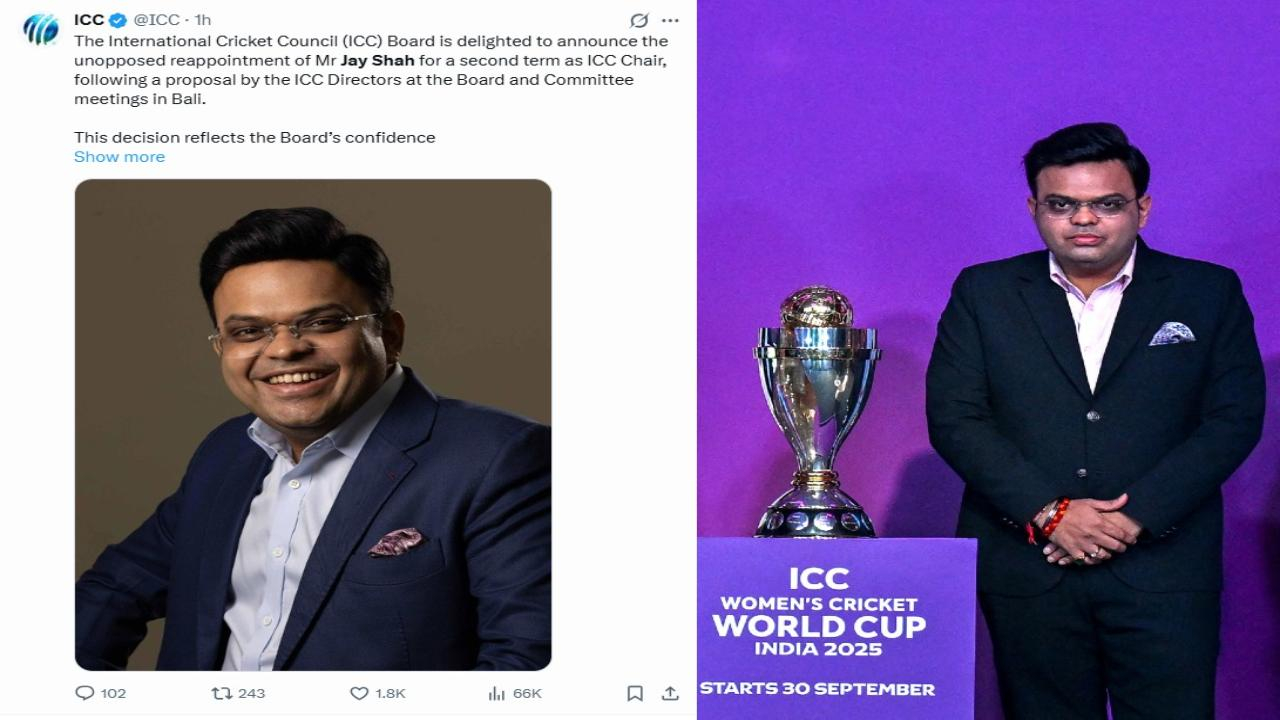
Jay Shah has secured a second consecutive term as Chairman of the International Cricket Council (ICC), becoming one of the most prominent figures in the governing body’s leadership history. The ICC confirmed his unopposed reappointment on November 16, 2026, following its Board meetings in Bali, Indonesia.
The announcement has once again brought attention to the full list of ICC chairpersons and former presidents, particularly the administrators who have led world cricket over the past three decades.
From Colin Cowdrey and Jagmohan Dalmiya to Shashank Manohar, Greg Barclay and Jay Shah, the ICC has witnessed several leadership changes since 1989. India has also maintained a significant presence in the organisation, with several Indian administrators occupying its top positions.
Jay Shah’s latest appointment is particularly important as the ICC prepares for cricket’s return to the Olympic Games at Los Angeles 2028. His second term will give the governing body continuity as it works towards expanding the sport’s global reach.
Jay Shah second term as ICC chairman: What happened?
The ICC Board officially confirmed Jay Shah’s reappointment for a second term on November 16, 2026. He was elected unopposed after being proposed by the ICC directors during meetings in Bali.
Shah initially took charge as ICC Chair on December 1, 2024, succeeding New Zealand’s Greg Barclay. Before becoming the head of world cricket’s governing body, he served as the BCCI secretary and held important administrative responsibilities within Indian cricket.
His first tenure coincided with preparations for cricket’s Olympic return, the expansion of international competitions and efforts to strengthen the game’s commercial position.
Reacting to his reappointment, Shah expressed gratitude to the ICC Board for its continued confidence.
“I am deeply honoured by the confidence the ICC Board has placed in me and sincerely grateful to every Director for their continued trust and support,” Shah said.
He also highlighted the importance of the LA28 Olympics, describing cricket’s return to the global sporting event as an opportunity to introduce the game to new audiences and inspire another generation of players.
Full list of ICC chairpersons from 2014 to 2026
The ICC introduced the modern Chairman position following constitutional changes in 2014. N. Srinivasan became the first person appointed to the position, while Shashank Manohar succeeded him in 2015.
Here is the ICC chairman list from 2014 to 2026:
| No. | ICC Chairperson | Nationality | Tenure |
|---|---|---|---|
| 1 | N. Srinivasan | India | 2014–2015 |
| 2 | Shashank Manohar | India | 2015–2020 |
| 3 | Greg Barclay | New Zealand | 2020–2024 |
| 4 | Jay Shah | India | 2024–Present |
Imran Khwaja’s interim role: Singapore’s Imran Khwaja served as interim ICC Chair from July 1 to November 23, 2020, during the transition following Shashank Manohar’s departure. He is not included as a separately elected Chair in the ICC’s official list of office bearers.
The leadership history shows India’s strong representation, with N. Srinivasan, Shashank Manohar and Jay Shah all holding the modern ICC Chair position.
All ICC presidents from 1989 to 2016
Before the modern Chairperson structure became the organisation’s main leadership arrangement, the ICC had a separate President position.
The presidency was abolished in 2016 following constitutional reforms. A total of 12 individuals held the position during the period covered by the ICC’s historical list.
Here is the complete list of ICC Presidents from 1989 to 2016:
| No. | ICC President | Nationality | Tenure |
|---|---|---|---|
| 1 | Colin Cowdrey | England | 1989–1993 |
| 2 | Clyde Walcott | West Indies | 1993–1997 |
| 3 | Jagmohan Dalmiya | India | 1997–2000 |
| 4 | Malcolm Gray | Australia | 2000–2003 |
| 5 | Ehsan Mani | Pakistan | 2003–2006 |
| 6 | Percy Sonn | South Africa | 2006–2007 |
| 7 | Ray Mali | South Africa | 2007–2008 |
| 8 | David Morgan | England | 2008–2010 |
| 9 | Sharad Pawar | India | 2010–2012 |
| 10 | Alan Isaac | New Zealand | 2012–2014 |
| 11 | Mustafa Kamal | Bangladesh | 2014–2015 |
| 12 | Zaheer Abbas | Pakistan | 2015–2016 |
The list includes several influential cricket administrators who helped shape international cricket during different periods.
Jagmohan Dalmiya was particularly influential in developing the commercial strength of the game, while Sharad Pawar also played an important role in cricket administration at the international level.
It is worth noting that Colin Cowdrey and Clyde Walcott had also served as ICC Chairmen under the earlier organisational structure. The modern Chairperson position and the historical presidency should therefore be understood as separate offices.
Shashank Manohar also secured a second consecutive term
One important detail in the ICC leadership history deserves attention.
Although Jay Shah has received a second consecutive term, he is not the first ICC Chairman to achieve this milestone.
Former ICC Chairman Shashank Manohar was elected unopposed for a second two-year term on May 15, 2018. He had initially become the first independent elected ICC Chairman in 2016 following constitutional reforms.
Manohar continued in the position until June 2020, completing approximately four years in ICC leadership.
This makes the Shashank Manohar second consecutive term an important historical comparison with Jay Shah’s latest reappointment.
Both administrators received another term without facing a contested election. Their appointments also demonstrate how the ICC has provided leadership continuity during important periods of structural and commercial development.
Therefore, Jay Shah’s reappointment is significant, but the claim that he is the first-ever ICC Chairman to receive consecutive terms would be historically incorrect.
Indian ICC chairpersons list: How India has shaped world cricket
India has maintained a strong presence in the ICC leadership structure.
Before the presidency was abolished, Jagmohan Dalmiya and Sharad Pawar represented India in the organisation’s top leadership position.
Following the introduction of the modern Chairperson role, N. Srinivasan became its first Indian office-holder. Shashank Manohar subsequently took charge, followed by Jay Shah in December 2024.
This means India has produced five individuals who have headed the ICC across the historical President and modern Chairperson positions: Dalmiya, Pawar, Srinivasan, Manohar and Shah.
The country’s growing commercial influence, the popularity of the Indian Premier League and its position in international cricket have all contributed to India’s importance in the global cricket administration landscape.
What lies ahead for Jay Shah and the ICC?
The ICC leadership history has entered another important phase with Jay Shah’s reappointment.
Cricket’s return to the Olympics at Los Angeles 2028 will be one of the biggest priorities during his second term. The event offers an opportunity to expand the game’s popularity in countries where cricket has traditionally had a limited following.
The governing body will also need to focus on strengthening international cricket, supporting Associate Members, expanding women’s cricket and maintaining a competitive balance between bilateral series and global tournaments.
Shah’s continued leadership provides the ICC with administrative continuity as it approaches this important period.
For cricket supporters, his reappointment is another major development in the history of international cricket administration.
Stay tuned with ROKOCRICKET for the latest cricket news, breaking updates, major appointments and exclusive developments from the world of sports. Subscribe to ROKOCRICKET to stay updated with every important cricket story.