India vs New Zealand 1st T20I: India chase 226 to extend unbeaten T20I run in New Zealand
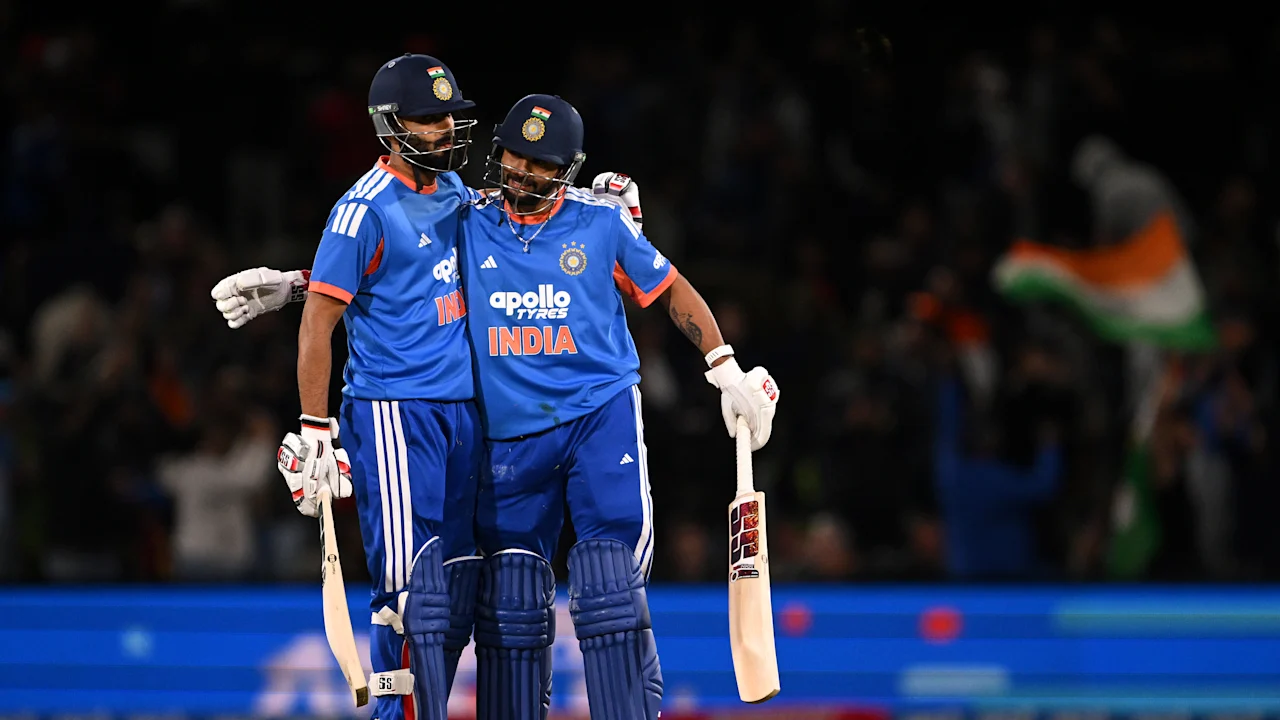
Sanju Samson and Naman Dhir celebrate India's record 226-run chase against New Zealand in the first T20I at Christchurch on October 22, 2026.
India began their New Zealand tour with a thrilling four-wicket victory in the first T20 International at Christchurch on October 22, 2026. Led by Shreyas Iyer, India chased down a challenging target of 226 with two balls to spare, recording their highest successful run chase in men’s T20I cricket, according to the match details provided.
Sanju Samson led the charge with an explosive 67 off 33 balls, while Iyer contributed 42 from 28 deliveries. Naman Dhir then produced a match-winning unbeaten 42 off just 15 balls to guide India home in a high-scoring contest at Hagley Park.
New Zealand had posted 225-4 after Glenn Phillips smashed an unbeaten 82 from 40 deliveries. However, India’s aggressive powerplay, middle-order contributions and Dhir’s late assault proved decisive in a contest that delivered several notable T20I records.
The result also continued India’s remarkable run in New Zealand, where the team has maintained an unbeaten record in T20I matches since its last defeat in February 2019, as described in the supplied match report.
Sanju Samson sets the tone with a blistering half-century
India’s record chase began with a statement of intent from Samson and Abhishek Sharma. The opening pair attacked from the outset, putting New Zealand’s bowlers under immediate pressure and giving the visitors the perfect platform for a demanding chase.
Samson scored 67 off 33 balls, striking eight fours and four sixes at a strike rate of more than 200. His aggressive approach ensured India stayed ahead of the required run rate during the opening overs.
Abhishek provided equally valuable support, scoring 29 off 12 deliveries. The pair added 93 runs for the first wicket, setting the tone for India’s pursuit of 226.
India reached 94-1 during the powerplay, making the first six overs one of the decisive phases of the match. New Zealand had struggled to contain the opening partnership, and India had already established a strong foundation for the chase.
However, Samson’s dismissal changed the momentum. India lost wickets in quick succession during the middle overs, allowing New Zealand to return to the contest.
Tilak Varma managed only six runs, while Ishan Kishan departed for one. With wickets falling, India needed its middle and lower order to deliver under pressure.
Shreyas Iyer and Naman Dhir finish the job
Captain Shreyas Iyer played a crucial role in stabilising India’s innings after the middle-order setbacks. His 42 off 28 balls provided the innings with much-needed direction, preventing New Zealand from taking complete control.
Iyer’s contribution was particularly important because India needed more than individual boundaries to complete such a challenging chase. The captain had to balance aggression with sensible strike rotation while keeping the required run rate within reach.
The decisive contribution, however, came from Naman Dhir.
Batting lower down the order, Dhir scored an unbeaten 42 from just 15 balls, including five fours and two sixes. His strike rate of 280 put New Zealand’s bowling attack under enormous pressure at a critical stage.
Rather than allowing the asking rate to dictate his approach, Dhir continued to find scoring opportunities and ensured India did not lose sight of the target.
India eventually reached 230-6 in 19.4 overs, winning by four wickets with two balls remaining.
Dhir’s innings also established a notable record. According to the supplied match statistics, his unbeaten 42 was the highest individual score by an Indian batter at No. 7 or lower in a successful T20I run chase, surpassing Irfan Pathan’s previous mark of 33.
For India, the performance highlighted the importance of contributions throughout the batting order. Samson provided the explosive start, Iyer steadied the innings and Dhir delivered the finishing punch.
Glenn Phillips powers New Zealand to 225
Earlier, New Zealand produced an aggressive batting display after Iyer won the toss and elected to bowl at Hagley Oval.
Glenn Phillips was the standout performer, scoring an unbeaten 82 from 40 balls. His innings featured eight fours and three sixes, giving the hosts the firepower needed to post a formidable total.
Finn Allen also made a significant contribution, scoring 45 from 24 deliveries with five fours and two sixes. His attacking approach helped New Zealand establish early momentum.
Daryl Mitchell added 28 from 19 balls before Bevon Jacobs provided late acceleration with 31 off 16 deliveries, including three sixes.
New Zealand finished on 225-4 in 20 overs, setting India a target of 226.
India’s bowlers found it difficult to contain the scoring throughout the innings. Bhuvneshwar Kumar, returning to international cricket, conceded 49 runs in four overs without taking a wicket. Axar Patel also endured an expensive spell, giving away 51 runs.
Mayank Yadav and Arshdeep Singh picked up a wicket each, while the Indian attack struggled to prevent Phillips and Jacobs from adding valuable runs towards the end.
Despite the challenging total, India’s batting depth ultimately proved decisive.
India extend their unbeaten T20I run in New Zealand
The Christchurch victory continued India’s impressive record in New Zealand’s home conditions. The team had last lost a T20I on New Zealand soil in February 2019, when the hosts secured a four-run victory in Hamilton.
India subsequently dominated the five-match T20I series in New Zealand in January and February 2020, winning every match. The series included two Super Over victories after the teams finished level.
India also won the 2022 T20I series in New Zealand, taking a 1-0 lead in a three-match contest affected by rain and a tied result.
The 2026 victory extends that unbeaten run to seven years and eight months since India’s last T20I defeat in New Zealand.
The result is significant because playing conditions in New Zealand can challenge visiting teams. Grounds, weather and the movement available to seam bowlers often make adjusting to local conditions an important part of a successful tour.
India’s ability to chase 226 in Christchurch demonstrated that its batting lineup could adapt to a high-pressure situation, even when the middle order lost wickets.
It also gave the visitors a valuable early advantage in the five-match T20I series.
Records from the India vs New Zealand first T20I
The Christchurch encounter produced several notable statistical milestones.
- India’s highest successful T20I chase: India successfully chased 226, surpassing its previous best of 209 against New Zealand in Raipur in January 2026.
- Naman Dhir’s record innings: His unbeaten 42 off 15 balls set a new benchmark for an Indian batter at No. 7 or lower in a successful T20I chase, according to the match statistics supplied.
- A dominant powerplay: India’s 94-1 in the first six overs put the visitors in a strong position early in the chase.
- Sanju Samson’s eighth 50-plus score of 2026: His 67 continued a productive year in T20I cricket and gave India the platform for victory.
- Glenn Phillips’ unbeaten 82: The New Zealand batter recorded the highest individual score of the match, but his effort was not enough to prevent defeat.
The match also underlined how quickly momentum can change in T20 cricket. New Zealand had posted 225, India started aggressively, and a middle-order wobble briefly reopened the contest. Dhir’s late hitting ensured the hosts could not turn that opportunity into a victory.
Stay tuned to ROKOCRICKET for the latest India vs New Zealand T20I news, match reports, cricket records, player performances and series updates. Subscribe to ROKOCRICKET and follow the action as the series continues.