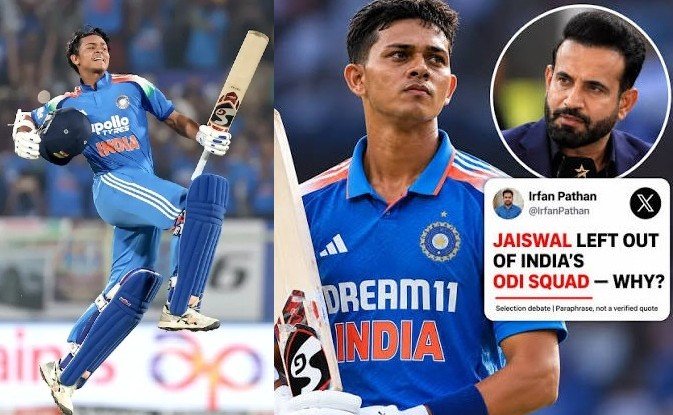

India’s decision to leave Yashasvi Jaiswal out of the ODI squad for the upcoming New Zealand tour has sparked debate among former cricketers and fans, with Irfan Pathan publicly questioning the selectors’ call.
The Board of Control for Cricket in India (BCCI) announced India’s squad on Friday, but Jaiswal’s absence quickly became one of the biggest talking points. The left-handed opener has made an impressive start to his international career in the 50-over format, yet he continues to struggle to secure a regular place in India’s white-ball plans.
Pathan, the former India all-rounder, took to X to raise a direct question about the selection decision. “Reason for Yashasvi Jaiswal not being there in the ODI squad?” he wrote.
The short post captured a wider concern surrounding Jaiswal’s future in India’s ODI setup. Despite producing strong performances in the opportunities he has received, the 24-year-old faces stiff competition for an opening position, with Rohit Sharma and Shubman Gill occupying the two spots.
His omission has also renewed discussions about whether India should give the young batter a longer run in one-day internationals or continue prioritising an established combination ahead of major tournaments.
Yashasvi Jaiswal’s ODI record makes his omission a talking point
Jaiswal’s limited ODI appearances have produced encouraging numbers. He has played six matches for India, scoring 71.25 runs per innings on average at a strike rate of 97.60. He has also registered two centuries in the format.
Those figures suggest that Jaiswal has made the most of his opportunities, although a six-match sample is too small to establish his long-term consistency at international level. Nevertheless, his record provides a reasonable basis for questioning why he has not featured more regularly.
India’s selection challenge is not simply about finding a talented opener. The team must balance individual form, experience, combinations and the requirements of its preferred batting order. Rohit brings extensive experience at the top, while Gill has established himself as a major part of India’s plans across formats.
That leaves Jaiswal competing for a place that may not become available unless the selectors decide to rotate their opening combination or give another player an extended opportunity.
For the youngster, the challenge is to remain consistent in domestic cricket and make every international opportunity count. For the selectors, the bigger question is whether his impressive numbers deserve another chance in the 50-over format.
R Ashwin also questions India’s selection strategy
Pathan is not the only former India international to question Jaiswal’s absence. Ravichandran Ashwin has also expressed disappointment over the decision, arguing that the opener deserved consideration for the New Zealand ODI series.
Ashwin’s concern centres on the limited opportunities available to Jaiswal in international cricket. He pointed out that the youngster could have been considered for the final two ODIs, particularly because Gill is scheduled to lead India only in the first three matches.
Ashwin also warned that repeatedly missing out on international opportunities could affect Jaiswal’s confidence. The former spinner believes selection should take recent performances into account rather than leave a talented batter waiting indefinitely for another chance.
The criticism has added weight to the debate, especially because India are building their combination with the 2027 ODI World Cup in mind. The upcoming New Zealand series offers the team an opportunity to assess players, strengthen combinations and identify reliable backup options.
However, the selectors have not publicly provided a specific explanation for Jaiswal’s omission. Any suggestion that the decision reflects a loss of confidence in his ability would therefore be speculation.
Why is Jaiswal struggling to find a place in India’s ODI team?
The biggest obstacle for Jaiswal is the competition at the top of the order. Rohit Sharma remains an established opening option, while Gill has been entrusted with leadership responsibilities in the first three ODIs against New Zealand.
India also have several players who can offer different combinations in the batting order. The selectors must consider whether a reserve opener can fit into the squad without disrupting the balance of the team.
Jaiswal’s natural position is at the top of the order, where he can make full use of the fielding restrictions during the powerplay. His aggressive approach and ability to convert starts into substantial scores make him an attractive option for one-day cricket.
But international teams rarely select players on statistics alone. The management also considers the role a player can perform, the opposition, the available squad places and the team’s plans for upcoming tournaments.
That creates a difficult situation for Jaiswal. He has shown that he can score heavily in ODIs, but he has not yet been given a sustained run that would allow him to establish himself as a regular member of India’s first-choice combination.
Jaiswal’s wicketkeeping experiment raises more questions
Away from the ODI selection debate, Jaiswal’s reported efforts to develop wicketkeeping skills have attracted considerable attention.
Pictures of the batter wearing wicketkeeping gloves during preparations for the 2026-27 Ranji Trophy season circulated on social media. Mumbai captain Siddhesh Lad subsequently indicated that Jaiswal had been working on wicketkeeping as an additional skill alongside batting and leg-spin.
The development led to speculation that Jaiswal might be exploring another way to improve his prospects in white-ball cricket. An additional skill can sometimes make a player more valuable when selectors are assembling a squad with limited places.
However, becoming an international wicketkeeper is a significant challenge. The role requires specialised technique, concentration, fitness and the ability to maintain consistent performance behind the stumps throughout long matches.
Former BCCI chief selector MSK Prasad questioned whether Jaiswal should pursue the role, stressing the importance of natural instincts and experience in wicketkeeping.
Former India opener Wasim Jaffer was similarly unconvinced. He questioned the wisdom of taking up such a demanding skill at 24, particularly when Jaiswal has already established himself as a specialist batter.
Jaffer also highlighted the competition for India’s wicketkeeping positions, with Ishan Kishan, Sanju Samson and Rishabh Pant among the available options.
His argument is straightforward: Jaiswal’s strongest asset is his batting, and spending substantial time developing wicketkeeping skills could distract him from improving the area that has already brought him international recognition.
There is, however, a distinction between learning wicketkeeping as a backup skill and attempting to become a first-choice international wicketkeeper. The former may provide additional flexibility, but it does not automatically guarantee selection.
What does the omission mean for Jaiswal’s future?
Jaiswal’s immediate priority is to continue scoring runs and remain ready for his next opportunity. His inclusion in India’s Test plans demonstrates that he remains part of the team’s thinking in the longest format, even as his position in the ODI setup remains uncertain.
The New Zealand tour also includes a two-match Test series, scheduled to begin on November 19. Jaiswal has been selected for the Test assignment and is expected to have an opportunity to continue his red-ball development.
He is also set to feature for India A in a red-ball series against New Zealand A ahead of the Test matches, giving him a chance to build match fitness and prepare for the longer format.
Still, the ODI omission will disappoint a player whose limited record in the format has been impressive. With the 2027 World Cup approaching, regular opportunities could be important for assessing whether he can become a long-term option at the top of India’s one-day batting order.
For now, the selectors have chosen not to include him in the New Zealand ODI squads. Whether that decision is part of a broader planning strategy or reflects the intense competition for opening positions remains unclear.
Pathan’s question has brought the issue into the spotlight, while Ashwin’s criticism has increased the pressure on the selection committee to explain its thinking.
Jaiswal’s performances have given supporters a reason to believe he deserves another opportunity. The challenge now is turning that promise into a regular place in India’s white-ball plans.
Stay tuned to ROKOCRICKET for the latest cricket news, team selection updates, player reactions and breaking sports stories. Subscribe to stay updated on India’s road to the 2027 ODI World Cup.