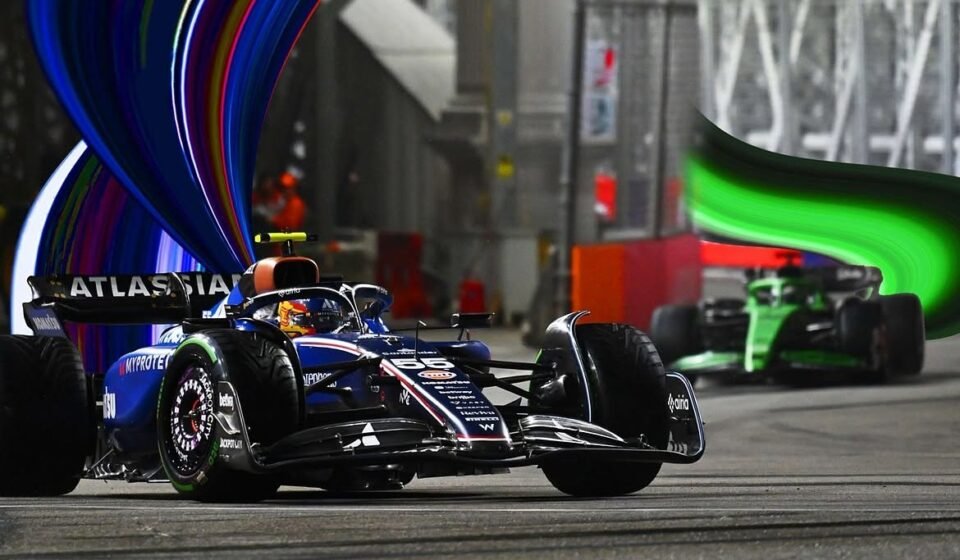

The Singapore Grand Prix has once again become one of the toughest physical tests on the Formula 1 calendar. The FIA has officially declared the 2026 event a heat-hazard race, triggering special measures designed to protect drivers from extreme cockpit temperatures and dehydration.
The declaration was made on October 8 after the official weather forecast indicated that the heat index would exceed 31°C at some point during the Sprint or Grand Prix. The FIA’s official documents confirm that the heat-hazard provisions apply to both competitive sessions at Marina Bay.
It is the fourth heat-hazard declaration of the 2026 F1 season, following the Austrian, Italian and Malaysian rounds. The designation was introduced after the extreme conditions seen at the 2023 Qatar Grand Prix, when several drivers struggled badly with heat and dehydration.
Why Singapore is so difficult for F1 drivers
Singapore’s problem is not simply the temperature on the weather forecast. It is the combination of heat, humidity, the physical nature of the Marina Bay circuit and the length of the race.
The Grand Prix is held at night, but that does not mean drivers get cool conditions. Temperatures can remain around 30°C after sunset, while humidity can be extremely high.
Inside the cockpit, the situation becomes considerably worse.
Formula 1 has previously reported cockpit temperatures reaching more than 60°C in Singapore, while George Russell explained that drivers can lose close to four kilograms of fluid during a race in these conditions.
That makes hydration a major part of race preparation. Drivers spend weeks preparing their bodies for the conditions, with heat training, controlled hydration and physical conditioning all becoming particularly important before arriving in Singapore.
The circuit itself adds another layer to the challenge. Marina Bay is a street track with numerous corners arriving in quick succession, limited opportunities for rest and the walls sitting close to the racing line.
There is little chance for a driver to relax.
For almost the entire race, they are working the steering wheel, brakes and pedals while sitting inside a cockpit that can become dramatically hotter than the outside air.
What happens when the FIA declares a heat hazard?
The heat-hazard system is designed to give teams an additional way of protecting drivers without compromising sporting fairness.
When a heat hazard is declared, cars must be prepared to use the approved driver cooling system. The FIA’s 2026 technical regulations specify minimum performance requirements for cooling systems, including the ability to extract heat from the driver under high ambient temperatures or provide a defined amount of stored cooling capacity.
The basic concept is relatively simple.
A cooling unit and reservoir are connected to tubing running through a fireproof garment worn underneath the driver’s race suit. Cooled fluid is circulated around the driver’s body to help remove heat while the car is running.
But making that system work for an entire Grand Prix is far more complicated.
The cooling liquid has to remain sufficiently cold for a long period while the driver is sitting in a tiny cockpit surrounded by hot components. If the cooling effect fades, the system becomes much less useful.
That is one reason the drivers and teams have different opinions about the technology.
Max Verstappen and Charles Leclerc see the problem differently
Max Verstappen has been openly sceptical about the current cooling system.
The Red Bull driver believes the system can restrict movement and does not provide enough cooling for the entire race. He has argued that if the system only remains effective for part of a Grand Prix, he would rather manage the heat himself.
Charles Leclerc, meanwhile, has taken a more positive position.
The Ferrari driver has indicated that even if the cooling system works effectively for only the first 15 to 20 laps, that period of relief can still be valuable. His argument is less about whether the system is perfect and more about whether it can reduce the physical burden on drivers for at least part of the race.
That debate highlights one of the biggest problems facing Formula 1: the technology has to be both effective and comfortable.
A cooling vest that works brilliantly but restricts the driver’s movement is not necessarily an ideal solution.
Why some teams are reluctant to use the cooling system
There is also a performance issue.
Formula 1 operates under a cost cap, meaning teams cannot simply spend unlimited amounts developing a perfect cooling system.
The FIA has created additional allowances for teams working on driver-cooling technology. According to reports, teams can receive an allowance of up to $50,000 for developing a system capable of keeping the liquid cool throughout a Grand Prix, with a further $75,000 available for developing a more comfortable garment.
Mercedes has decided that the available allowance was not enough to justify diverting significant development resources away from the car itself.
That creates an unusual situation.
A driver can choose not to use the cooling system, but sporting regulations require the car to carry additional weight so that refusing the cooling equipment does not provide a performance advantage.
For a heat-hazard race, the heat-hazard mass increase is 5kg under the 2026 technical regulations.
Five kilograms may sound small outside motorsport, but in Formula 1 it can influence lap time, tyre performance and overall race strategy.
Singapore’s haze creates another concern
The heat is not the only environmental issue surrounding this year’s race.
Singapore is also dealing with haze associated with fires in Indonesia. Air quality has become a concern ahead of the Grand Prix, with authorities and event organisers preparing contingency measures if conditions deteriorate.
The FIA has indicated that the race itself is expected to continue, although some outdoor entertainment and activities could be affected if the haze becomes worse. Rain could help improve conditions, but wind direction will also play a role.
Singapore has experienced serious haze episodes before. The 2019 Grand Prix, for example, was held amid concerns about unhealthy air caused by Indonesian forest fires.
For Formula 1, the situation is being monitored alongside the heat because drivers already face an unusually demanding environment.
The real test begins after the lights go out
The Singapore Grand Prix is often described as a night race, but that label can make the event sound easier than it really is.
There is no escaping the humidity. There is no easy way to cool down inside the cockpit. Drivers cannot simply slow their heart rate on a long straight because Marina Bay constantly demands concentration and physical input.
That is why the heat-hazard declaration matters.
It is not a prediction that drivers will be unable to finish the race. Instead, it recognises that the environmental conditions can create an additional safety risk and gives teams the equipment and regulations needed to manage it.
The bigger question is whether the current cooling technology is good enough.
The contrasting views from Verstappen, Leclerc and other drivers show that Formula 1 still has work to do. A system that can reliably keep a driver cool for the full duration of a race would remove one of the biggest compromises.
Until then, Singapore remains a race where fitness can be just as important as outright car performance.
And with the 2026 championship battle already entering a crucial stage, drivers will have little choice but to push through the conditions.
For fans, the Singapore Grand Prix promises another spectacular night under the lights. For the 20 drivers inside those cars, however, it could be one of the most physically demanding weekends of the entire season.
Stay tuned with ROKOCRICKET for more Formula 1 news, race updates and major sporting stories. Subscribe and keep following us for the latest developments from the world of sport.