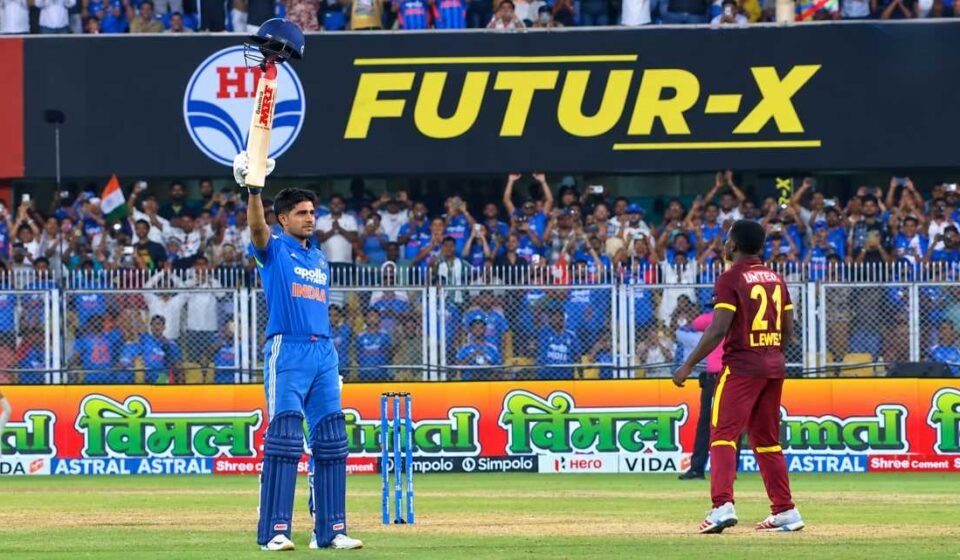

The India vs West Indies second ODI in Guwahati produced the kind of batting spectacle that rarely comes around in one-day cricket. West Indies put up a huge 405/7, but India responded with an even more extraordinary performance, chasing down 406 in only 43.3 overs to win by eight wickets.
At the centre of India’s stunning chase was captain Shubman Gill, who produced the biggest ODI innings of his career with an unbeaten 223. Rohit Sharma also played a major role, scoring a brilliant 101 off 75 balls before becoming the first Indian wicket to fall.
The result gave India their highest successful chase in men’s ODI cricket, surpassing their previous best of 362 against Australia in Jaipur in 2013. It also became the second-highest successful chase in ODI history, behind South Africa’s 438-run chase against Australia in Johannesburg in 2006.
Gill turns a massive chase into a batting masterclass
When West Indies finished on 405/7, India appeared to have an enormous task on their hands. But Gill made the target look surprisingly manageable.
The Indian captain remained unbeaten on 223 from 132 balls, combining control with extraordinary attacking cricket. His innings included 24 fours and seven sixes, and he reached his double century in only 117 balls. That made it the fastest ODI double century recorded.
Gill’s innings also placed him in an exclusive club.
He became only the second batter in men’s ODI cricket to score multiple double centuries, joining Rohit Sharma. Gill had already registered his first ODI double hundred earlier in his career, but this innings was different because it came in a huge successful chase.
It was also a landmark performance for Gill as India’s ODI captain. He was appointed captain for the West Indies ODI series as India continue preparations for the 2027 ICC Men’s Cricket World Cup.
The timing of his innings made it even more remarkable. India needed to score at more than eight runs per over for much of the chase, yet Gill never appeared rushed. He repeatedly found gaps, punished loose deliveries and used the shorter boundaries effectively.
Rohit Sharma joins the 12,000-run ODI club
Before Gill took complete control of the evening, Rohit Sharma provided the perfect start.
The veteran opener smashed 101 from 75 balls, giving India exactly the kind of platform required for a chase of 406. His century came with aggressive strokeplay and helped India establish momentum before he was dismissed.
But the innings had another historic dimension.
Rohit crossed the 12,000-run mark in ODI cricket, becoming only the seventh batter in men’s ODI history to reach the milestone. He also reached the landmark faster than several legendary names, including Sachin Tendulkar, Ricky Ponting and Kumar Sangakkara, according to reports on the achievement.
That means India’s batting lineup witnessed two major milestones in the same innings: Rohit’s 12,000 ODI runs and Gill’s second ODI double century.
For a player who has already built a reputation around enormous ODI scores, Rohit’s latest milestone adds another significant chapter to his career.
West Indies create history before India respond
The chase would not have been possible without an extraordinary first innings from West Indies.
The visitors scored 405/7, their highest-ever ODI total. Three West Indies batters reached centuries in the same innings: John Campbell scored 101, Shai Hope made 104 and Amir Jangoo smashed 114.
It was a remarkable batting effort, particularly because scoring 400-plus against India is a rare achievement. West Indies’ total also represented their highest ODI score against India.
The three-centurion performance added another unusual statistic to the match. West Indies became one of the few teams in ODI history to have three batters score centuries in the same innings.
But even 405 was not enough.
India’s response was so dominant that the target of 406 disappeared from the scoreboard with 39 balls still remaining.
India rewrite their own chasing record
Before this match, India’s highest successful ODI chase was 362/1 against Australia in Jaipur in 2013.
That record has now been completely rewritten.
India’s 406/2 in Guwahati is not only their highest successful chase but also one of the biggest successful run chases ever seen in men’s ODI cricket. Only South Africa’s famous 438-run chase against Australia in Johannesburg in 2006 remains higher.
The scale of India’s achievement becomes clearer when looking at the margin. Chasing 406 is difficult enough; doing it with eight wickets in hand and more than six overs remaining makes the performance even more extraordinary.
The match therefore enters India’s ODI record books alongside some of the format’s most memorable batting performances.
India’s 400-plus ODI numbers
India’s latest performance also strengthened their position among the teams that have most frequently crossed the 400-run mark in ODI cricket.
India now have nine ODI totals of 400 or more, according to the figures from the match coverage, putting them ahead of South Africa and England in this particular list.
The latest effort was different, however. Rather than simply posting 400 themselves, India successfully chased a target of 406.
That distinction makes the Guwahati performance particularly memorable.
A night of records for Indian cricket
There were several storylines running simultaneously at the Barsapara Cricket Stadium.
West Indies produced their highest ODI total.
Three West In