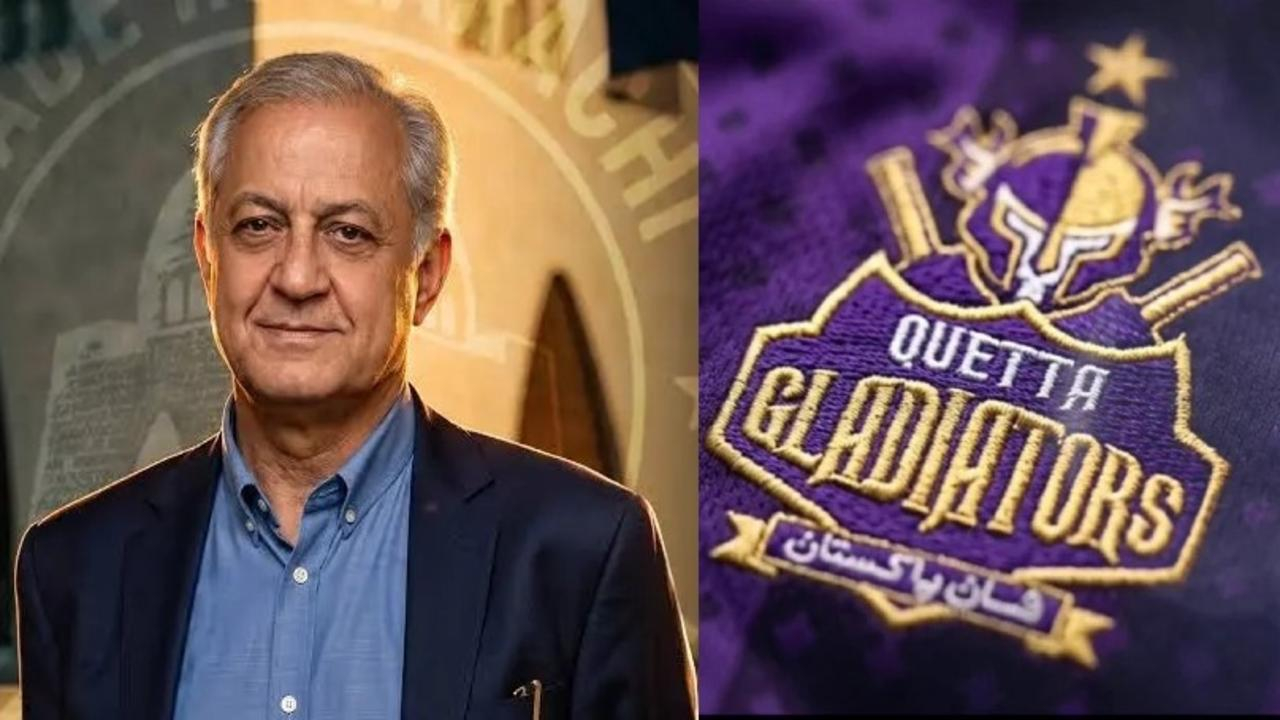
The Nadeem Omar Quetta Gladiators sale discussion has become one of the biggest talking points in Pakistan cricket, with the franchise owner openly admitting that he is ready to part ways with the team if he receives the right offer. After spending years building one of the Pakistan Super League’s (PSL) most recognisable franchises, Omar believes the financial realities of the competition have made it increasingly difficult to continue.
The Quetta Gladiators owner Nadeem Omar has also delivered a strong assessment of the growing financial difference between the PSL and the Indian Premier League (IPL). According to him, Pakistan’s limited commercial market, lack of major sponsors and difficulties generating merchandise revenue have prevented the PSL from reaching the same financial level as its Indian counterpart.
Omar revealed that Quetta Gladiators had operated at a loss for seven years despite enjoying considerable success on the field. Reports have also suggested that the franchise could be available for approximately PKR 3 billion, equivalent to around US$10.86 million.
However, the reported valuation has not been officially confirmed by Omar or the Pakistan Cricket Board (PCB). No ownership transfer has been announced.
His latest comments have raised important questions about the future of Quetta Gladiators and the financial sustainability of the PSL ahead of the 2027 season.
Why Nadeem Omar wants to sell Quetta Gladiators
Omar has made it clear that he is not ruling out an exit from the competition. The businessman believes the time could be right to move on if a suitable buyer meets his conditions.
“I think it is the right time for us to say goodbye to the PSL and if we get the right offer and few of our conditions are met we are prepared to sell the Quetta Gladiators franchise,” Omar said.
His statement provides a significant indication of the uncertainty surrounding the franchise’s long-term ownership.
The Nadeem Omar reveals seven years of PSL financial losses story is particularly surprising because Quetta Gladiators have remained competitive throughout their history in the tournament.
Omar admitted that the team had spent seven years in the red, a business term used when an organisation operates at a financial loss.
“I feel the success we could have given to Quetta Gladiators we could not do that. For seven years, we were in the red. I had a lot of plans but I don’t think we achieved all of them,” he explained.
For a franchise that has reached several PSL finals and won a championship, the admission highlights the difference between sporting achievements and financial returns.
PSL vs IPL financial gap remains a major concern
One of the strongest points raised by Omar concerns the commercial difference between the Pakistan Super League and the Indian Premier League.
The PSL vs IPL financial gap has become increasingly difficult to ignore, particularly since both competitions began operating during the same March-to-May window in 2025.
Omar believes trying to compete directly with the IPL was a mistake because the two tournaments operate in completely different commercial environments.
“We can’t compete with the IPL or with their market. Our market is very limited compared to them. Unfortunately, we don’t have sponsors and commercial entities putting money into the PSL like it is done in the IPL,” he said.
The IPL has developed a massive commercial ecosystem through broadcasting agreements, sponsorship deals, ticket sales, merchandise and international brand partnerships.
Its franchises benefit from a much larger consumer market and greater opportunities to attract corporate investment.
The PSL, meanwhile, continues to operate within a comparatively smaller market. Although it has developed a strong reputation for competitive cricket, generating similar commercial returns remains a major challenge.
Omar also pointed towards the financial strength of IPL franchises, arguing that the difference in team valuations makes direct comparisons difficult.
For Pakistan cricket, the challenge is not simply attracting international players but building a business model that allows franchise owners to earn sustainable returns.
Merchandise and sponsorship problems hurt PSL franchises
Another major concern highlighted by Omar was the difficulty of generating revenue through official merchandise.
He explained that Quetta Gladiators had attempted to sell official team shirts for PKR 1,000, but unofficial copies were available in the market for approximately PKR 200.
This price difference makes it difficult for franchises to compete with counterfeit merchandise and earn meaningful revenue from supporters.
“Merchandising in the IPL is huge, and the gate money for home and away matches are big earners for franchises in the IPL apart from their broadcasting share,” Omar said.
He believes the PSL has failed to develop similar commercial opportunities, leaving franchise owners dependent on a more limited revenue structure.
Broadcasting revenue, sponsorship agreements and ticket sales remain important parts of franchise cricket. However, the ability to generate additional income through merchandise and brand partnerships can make a significant difference to a team’s overall financial position.
Omar’s comments suggest that the PSL needs to strengthen these areas if it wants to retain its existing owners and attract new investors.
Quetta Gladiators’ reported sale price reaches $10.86 million
The Quetta Gladiators reported sale price $10.86 million has attracted attention as speculation surrounding the franchise’s ownership continues.
Reports have placed the proposed valuation at approximately PKR 3 billion, although neither the franchise nor the PCB has officially confirmed the figure as an agreed asking price.
A potential sale would represent a significant development for the PSL, particularly because Quetta Gladiators were among the original franchises when the competition launched in 2016.
Omar reportedly acquired the franchise for an annual bid price of approximately US$1.1 million, the lowest among the original teams. He has acknowledged that the relatively low initial cost helped him manage the financial commitment during the league’s early years.
If a deal eventually happens, Quetta Gladiators would become another PSL franchise to experience an ownership change following Multan Sultans.
However, a reported valuation should not be confused with a completed transaction. Any ownership change would require the necessary agreements and PCB approval.
Nadeem Omar wanted PSL matches in Quetta
Beyond the financial discussion, Omar also expressed disappointment over several personal ambitions that he could not fulfil during his association with the franchise.
The businessman revealed that his decision to purchase Quetta Gladiators was not based entirely on commercial interests. He wanted to contribute to Pakistan cricket, particularly by developing opportunities for players from Balochistan.
“I didn’t buy the team just as a business. I also wanted to do something for Pakistan cricket. I wanted matches in Quetta. I wanted to give exposure to players from Balochistan. It didn’t happen for many reasons,” he said.
Bringing PSL matches to Quetta could have provided local supporters with an opportunity to watch top-level franchise cricket in their own city.
It could also have helped young cricketers from Balochistan gain greater visibility and encouraged more investment in the region’s cricket infrastructure.
Unfortunately, those ambitions never materialised, becoming another source of disappointment for Omar.
Despite the challenges, Quetta Gladiators have established a strong sporting history. The franchise has reached four PSL finals, winning its first and only championship in 2019.
They also finished runners-up in 2016, 2017 and 2025, demonstrating their ability to compete at the highest level.
What does the Quetta Gladiators future look like ahead of PSL 2027?
The Quetta Gladiators future ahead of PSL 2027 is now an important question for supporters and the wider cricket community.
The possibility of a sale comes despite the franchise renewing its agreement with the PCB in November 2025 for another 10 years, covering the 2026-2035 period.
That long-term commitment makes Omar’s latest comments particularly significant.
However, his willingness to sell does not mean that the franchise has officially changed ownership. The next steps will depend on negotiations, the availability of a suitable buyer and the conditions attached to any potential agreement.
For the PSL, the situation also presents an opportunity to examine whether its current financial structure provides enough support for franchise owners.
Omar has acknowledged that the competition remains among the leading franchise T20 leagues in the world because of its competitive cricket and established reputation.
His criticism is largely directed towards the commercial model and the expectations placed on franchises operating in a smaller market.
Whether Nadeem Omar eventually completes a sale or continues his journey with Quetta Gladiators, his comments have highlighted an important issue for Pakistan cricket.
The PSL has successfully established itself as a major T20 competition, but its next challenge will be ensuring that sporting success translates into long-term financial stability.
Stay tuned to ROKOCRICKET for the latest Quetta Gladiators updates, PSL 2027 news, franchise ownership developments and breaking cricket stories. Subscribe to ROKOCRICKET to stay connected with the biggest developments from the world of sports.