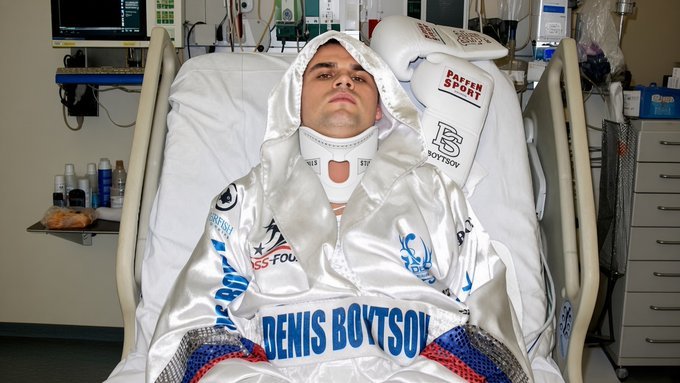

Former Russian heavyweight boxer Denis Boytsov, once regarded as one of the most promising contenders in professional boxing, has died at the age of 40 after spending 11 years in care following a mysterious incident in Berlin that left him with severe brain injuries.
Boytsov’s death was confirmed by his father, Nikolai Boytsov, who told Russian news agency TASS that a blood clot had detached, causing his son to die suddenly at home. The former boxer had been unable to speak since suffering devastating head injuries in 2015, bringing an abrupt end to a career that had once promised a place among the heavyweight division’s leading names.
His death marks the tragic conclusion to a story that began with extraordinary sporting potential but took a heartbreaking turn when he was found unconscious in a Berlin subway tunnel in May 2015. He was 29 at the time, with much of his professional career still ahead of him.
Denis Boytsov’s boxing career and impressive record
Born in Russia, Denis Boytsov developed a reputation as a powerful heavyweight puncher during his rise through the professional ranks. His combination of punching power, aggression and finishing ability made him a dangerous opponent, particularly during the early stages of his career.
Boytsov compiled a professional record of 36 victories and one defeat, establishing himself as a serious contender in the heavyweight division. At one stage, he was ranked No. 2 in the world behind fellow heavyweight Wladimir Klitschko, according to the career assessments reported during his rise.
For a boxer competing in one of the sport’s most physically demanding divisions, that position represented a significant achievement. Heavyweight boxing often rewards a combination of strength, timing, movement and the ability to deliver decisive punches. Boytsov’s reputation rested heavily on his power, which made him an intriguing prospect for major international contests.
His career also brought him close to a potential showdown with British heavyweight Tyson Fury. The two were scheduled to meet in December 2012, but Boytsov withdrew from the planned fight. The contest never took place, leaving boxing fans without the opportunity to see the Russian contender tested against a fighter who would later become one of the defining heavyweights of his generation.
Although Boytsov never reached the heights many had anticipated, his record and world ranking demonstrated why he had attracted attention in heavyweight boxing. His career was still a work in progress when the events of 2015 changed everything.
What happened to Denis Boytsov in Berlin?
In May 2015, Boytsov was discovered unconscious in a subway tunnel in Berlin, suffering from severe head injuries. The circumstances surrounding how he ended up there were never fully established publicly.
The injuries were life-changing. Boytsov required intensive medical treatment and was placed in a medically induced coma because of swelling in his brain. The damage left him unable to return to professional boxing and severely affected his ability to communicate.
At the time, concerns emerged that the incident might have involved an assault. A statement published on his website suggested that his boxing career could have been connected to what happened, noting that he had allegedly received repeated threats approximately two years earlier.
The statement said it was possible the incident was linked to his sporting activities. However, that possibility was never established as fact.
Boytsov’s wife, Olga Litvinova, also expressed concerns that he might have been targeted. Despite those suspicions, the precise circumstances of the incident remained unresolved, and no perpetrators were publicly identified in the accounts surrounding the case.
It is important to distinguish those concerns from proven findings. While the possibility of an attack was raised at the time, the available accounts do not establish who was responsible or exactly how Boytsov sustained his injuries.
The lack of a clear public explanation left a lasting question mark over the incident that ended the Russian boxer’s career.
Denis Boytsov’s final years and his family’s heartbreaking memories
The years following the Berlin incident were marked by extensive care and the lasting effects of Boytsov’s brain injuries. A boxer once known for his strength and physical ability became dependent on others for everyday support.
His brother, Maxim Boytsov, offered a painful glimpse into the family’s experience in an interview with the Daily Mail. He explained that his brother appeared to understand what people were saying but could no longer speak.
According to Maxim, communication was limited largely to nodding to indicate yes or no. His account highlighted the extent of the damage Boytsov had suffered and the difficulty his family faced in maintaining a connection with someone who could no longer communicate normally.
For relatives, the tragedy extended far beyond the loss of a sporting career. Boytsov’s injuries affected his independence, his relationships and the ordinary experiences that many people take for granted.
His family’s accounts also underlined how the consequences of a serious brain injury can continue for years. Although he survived the initial medical emergency, Boytsov never recovered sufficiently to resume the life he had known before 2015.
His death at 40 now brings that long and difficult period to an end.
David Price remembers Boytsov’s punching power
Former British heavyweight boxer David Price was among those who remembered Boytsov as an exceptionally powerful puncher.
Price, who defeated Fury as an amateur in 2005, recalled sparring with the Russian in Germany. He described Boytsov as a fighter whose punching strength left a strong impression, even during training.
Price said Boytsov had struck the top of his head during their sparring session, but the power of the punches was what stayed with him. He also expressed regret that Boytsov’s career had been cut short by the injuries he suffered.
Price’s recollections offer a reminder of the respect Boytsov commanded among fellow heavyweights. Sparring accounts cannot establish how a fighter would have performed in every major contest, but they provide an insight into the physical qualities that helped build his reputation.
For Boytsov, those qualities had once offered the possibility of competing against the biggest names in boxing. Instead, his career ended before he could fulfil the expectations surrounding him.
Denis Boytsov’s death leaves a tragic boxing legacy
Boytsov’s story is a sobering reminder of how quickly a promising sporting career can be derailed by circumstances outside the ring. With 36 professional victories, a high world ranking and a potential fight against Fury once on the schedule, he had established himself as a heavyweight worth watching.
Yet his legacy is not defined by statistics alone. It is also shaped by the unresolved questions surrounding the Berlin incident, the years of care that followed and the experiences of a family that watched a talented athlete struggle with the consequences of catastrophic injuries.
According to his father, Boytsov died after a blood clot detached, with the fatal episode occurring at home. His funeral was scheduled for Oct. 18 in Russia’s Oryol region.
The boxing community has lost a former contender whose career ended far too soon. For those who followed his rise, Boytsov will be remembered both for the power that made him a feared opponent and for the tragedy that prevented him from reaching his full potential.
Stay tuned to ROKOCRICKET for more boxing news, major sporting updates and the latest stories from the world of combat sports. Subscribe to stay informed about the athletes, rivalries and events shaping the sporting world.